The Drop

News and Resources from AXIS Flight School


  • We’ve had a pretty big YouTube channel for a pretty long time, but there are certain videos that never stop finding new eyeballs.

    This is one of ’em. If your own eyeballs haven’t found it yet, we hope you like it.

    Right?!

    Here’s the the full backstory.

    The Setup

    It’s 2011. Prince William marries Kate Middleton. The final Harry Potter film gets released. Game of Thrones premiers. Steve Jobs dies. And this jump happened. (Whoa.)

    We were at Skydive Moab, taking part as organizers at the M.O.A.B. To be fair, it was Mike Bohn who originally floated the idea: what if we took a bowling ball into freefall?

    Yeah. Okay. Let’s do it.

    Figuring Out the Fall Rate

    Nobody knew exactly how a bowling ball would behave in freefall. We added streamers — partly for visibility, partly for drag — and went in with our best guesses. The result surprised everyone, actually: it fell at roughly a fast belly speed, but a slow freefly speed. That sweet spot meant the jumpers could fly around it in multiple body orientations, kicking it back and forth on the way down. You can see that playfulness in the footage — nobody’s fighting the object, they’re flowing with it.

    The Rules of Dropping Stuff Outta Planes

    We would be remiss if we didn’t cover the legal bits, right?

    § 91.15 Dropping objects. Title 14 (Aeronautics and Space) — Part 91 — Section 91.15

    No pilot in command of a civil aircraft may allow any object to be dropped from that aircraft in flight that creates a hazard to persons or property. However, this section does not prohibit the dropping of any object if reasonable precautions are taken to avoid injury or damage to persons or property.

    For anyone wondering whether you can legally toss a bowling ball out of an aircraft: technically, yes — with caveats. FAA regulations do permit dropping objects from aircraft, provided you can ensure the object won’t damage property or injure anyone. That’s why we spotted the aircraft over open BLM land deep in the Utah desert, well clear of people, structures, and roads. We factored in wind drift (which can be as strong in the desert as anywhere) to make sure the ball’s impact point stayed in the clear, and we had a ground crew ready to locate and retrieve the ball afterward.

    Critically, the pilot was looped in on the plan, too. That particular communication matters, because the pilot shares regulatory responsibility for anything released from the aircraft.

    As Brianne put it: “use good planning, and good consideration, follow the rules, and clean up your trash.”

    Building Freefall Objects Is Trial and Error

    The bowling ball was the simplest version of this kind of project: a heavy, symmetrical object with streamers attached. But the AXIS crew had also been doing “sky ball” jumps around the same boogie, building custom tennis balls filled with lead shot and experimenting with how much weight produced the right fall rate for different body positions. That kind of R&D is more art than science: you build it, drop it, observe, and adjust.

    The Bigger Picture: Moab

    The boogie itself was memorable beyond the stunts. The boogie heavily involves “Inn-hopps” (jumping offsite areas, which is to say scenic flights to remote landing zones not usually landed-in by parachutes). Oh–and packing in the dining room of a ranch house that, as Nik recalls, “had a slide going from the bedroom down into the living room.” (We also took a trip to nearby Arches National Park at night, where Nik did some night photography among the sandstone formations. PSA: skydiving trips are about more than just the jumps.)

    Why It Still Resonates

    We get why people still watch this ancient video. There’s something irresistible about the premise, right? A bowling ball in freefall is absurd enough for even a whuffo to click on, and the daydream for many sport skydivers is strong enough to watch it twice. Fourteen years later, the video is still one of the most-watched on the AXIS Flight School channel.

    Want to see what else our AXIS crew has gotten up to? Check out the full Stunts playlist on our channel:
    And if you’re serious about levelling up your own skydiving, reach out to us at https://www.axisflightschool.com.

  • Is a helicopter jump on your bucket list? Check out the Skydive Arizona events page for the next available Huey jumps.

  • In this installment, we help you use the precision landing protocols shared in the previous installments even when the world is not cooperating with your plans.

    Enjoy!

    Editors Note (illustration clarification): In the second image above (Medium/Strong Winds), the final leg should be shorter and the base leg closer to the target than the No/Light wind image. This means the canopy pilot has to implement a slight crabbing angle on the base leg.


    To view past issues of the series, click on the links below:

    Part 1: Beyond Imprinting

    Part 2: Holding Area

    Part 3: Landing Pattern

  • If you missed (or want to refresh yourself on) the previous chapter (part 2), click here.

  • Our friends in Ol’ Blighty invited us to share our work on slow flight (previously published by Parachutist on this side of the pond), and we were glad to oblige. We’re pretty pleased with how it came out!

    Any questions about the content? Hit us up.

  • The December 2025 Issue of Parachutist is hitting mailboxes. 💌

    As promised, in it is the next installment of Foundations of Flight: Approaching with Confidence. Enjoy! And remember that we’re always here to answer your questions.

    If you missed (or want to refresh yourself on) the previous chapter, click here.

  • Concluding the 2025 ISSA World Cup Series

    The ISSA World Cup Series 2025 brought together over 61 competitors from 12 countries facing off across three continents in eight high-speed events to determine the world’s top speed skydivers.

    The ISSA World Series 2025 consisted of 8 separate meets, with the season culminating in Eloy, Arizona, with the eighth and final event hosted by AXIS Flight School at Skydive Arizona. This past weekend, 15 competitors from the United States and Europe met in Eloy for the final showdown.

    In the open event at Eloy, Niklas Daniel (USA) claimed victory with another superb performance across eight rounds, posting an average speed of 521.02 km/h. Fabian Wernli (SUI) secured second place, while Jordan DuJack (USA) rounded out the podium in third.

    Niklas Daniel receives the ISSA Trophy from ISSA representative Fabrian Wernli.

    In the female class, Anna Lea (GBR) dominated with a remarkable average speed of 453.52 km/h. Brianne Thompson (USA) took second place, followed by Jessica Twarog (USA) in third.

    In the overall winners 2025 standings, competing the World Cup Series Finals on their home base gave Niklas Daniel and Brianne Thompson a strong motivational boost. Niklas took the lead with his excellent performance, finishing ahead of Mervin O’Connel (AUS). The competition for third place was extremely close, with Thomas de Raat (NED) securing the spot by just 0.5 points in front of Marco Hepp (GER).

    Brianne also delivered in the final, winning the overall women’s standings ahead of Sara Lundqvist (SWE) and Ingrid van Deelen (NED). Just 4.5 points separated first and third place.

    This is AXIS Flight School’s Niklas Daniel second consecutive ISSA World Cup Series Title. Current FAI World Champion and 2024 ISSA World Cup Champion Niklas Daniel was able to defend possession of the ISSA Earnest Holford Memorial Sword and will get to keep it for another year. Niklas Daniel receives the ISSA Trophy from ISSA representative Fabian Wernli.

    2025 ISSA World Cup Series Champion Niklas Daniel with the ISSA Earnest Holford Memorial Sword. Photo by Kay Robinson.
    🤔 How the World Series scoring works:
    Wherever a competitor did not participate in an event, the result for that meet(s) is zero. The World Series overall result is the sum of the two best meet results for each competitor regardless of the number of events completed (points per meet = meet result of a single meet). At the completion of the series, the competitor with the most points at the end of the year is declared the ISSA Speed Skydiving World Cup Series Champion 2025.
    For the complete list of results, visit: https://www.issa.one/issa-world-cup-series-2025/

  • Top left to right: Brianne Thompson, Anna Nordin, Jessica Twarog, David Robinson, Niklas Daniel, Jordan DuJack, Fabian Wernli, Bernhard Russegger, Alexander Salcher.
    Bottom left to right: Alex Lilburn, Anna Lea, Joel WIlliamson, Alexander Osborn, Ken Nguyen, Robert “Bob” Carlton. Photo by Kay Robinson at Skydive Arizona.

    The AXIS Flight School hosted the ISSA World Cup Series Event of 2025 at Skydive Arizona has wrapped, following a full-throttle weekend of Speed Skydiving on December 13–14, 2025.

    Over the weekend, 14 competitors gave it everything they had, chasing one simple goal: fly as fast as humanly possible.

    👉 Competitor Snapshot 👈
    11x male | 4x female
    5x nationalities
    4x competitors in their 30s; 6x in their 40s; 1x in their 50s; 2x in their 60s; 1x in their 70s

    Many athletes set new personal bests, updating their Eternal Rankings. We also welcomed a couple of newcomers to the discipline: Ken and David.

    Speed Skydiving keeps getting stronger every year. Word on the street is that 2026 will see 3 ISSA events in the USA alone. There is also growing desire for USPA and FAI to adopt a Masters Class, especially given that 4 competitors were over the age of 50 at the Eloy meet alone. The Junior category (24 years of age or younger) has been a staple for many years now.

    Special thanks to Michael at Flysight for providing the competition units.

    And thank you to every competitor, especially those who traveled here from the other side of the globe. The sportsmanship and camaraderie were unmistakable all weekend.

    Special thanks as well to the Skydive Arizona staff and pilots who made this event possible. Training for and participating in ISSA events is a great way to learn and get exposure to Speed Skydiving. For information about future events and coaching, visit www.AXISFlightSchool.com

    https://skyderby.ru/events/speed_skydiving/168

    Remote judging team: Toby Adams and Alix Raymond.

    Let’s see the podiums 🏆

    Open: (3) Jordan DuJack, (1) Niklas Daniel, (2) Fabian Wernli. Photo by Kay Robinson.
    Female: (3) Jessica Twarog, (1) Anna Lea, (2) Brianne Thompson. Photo by Kay Robinson.
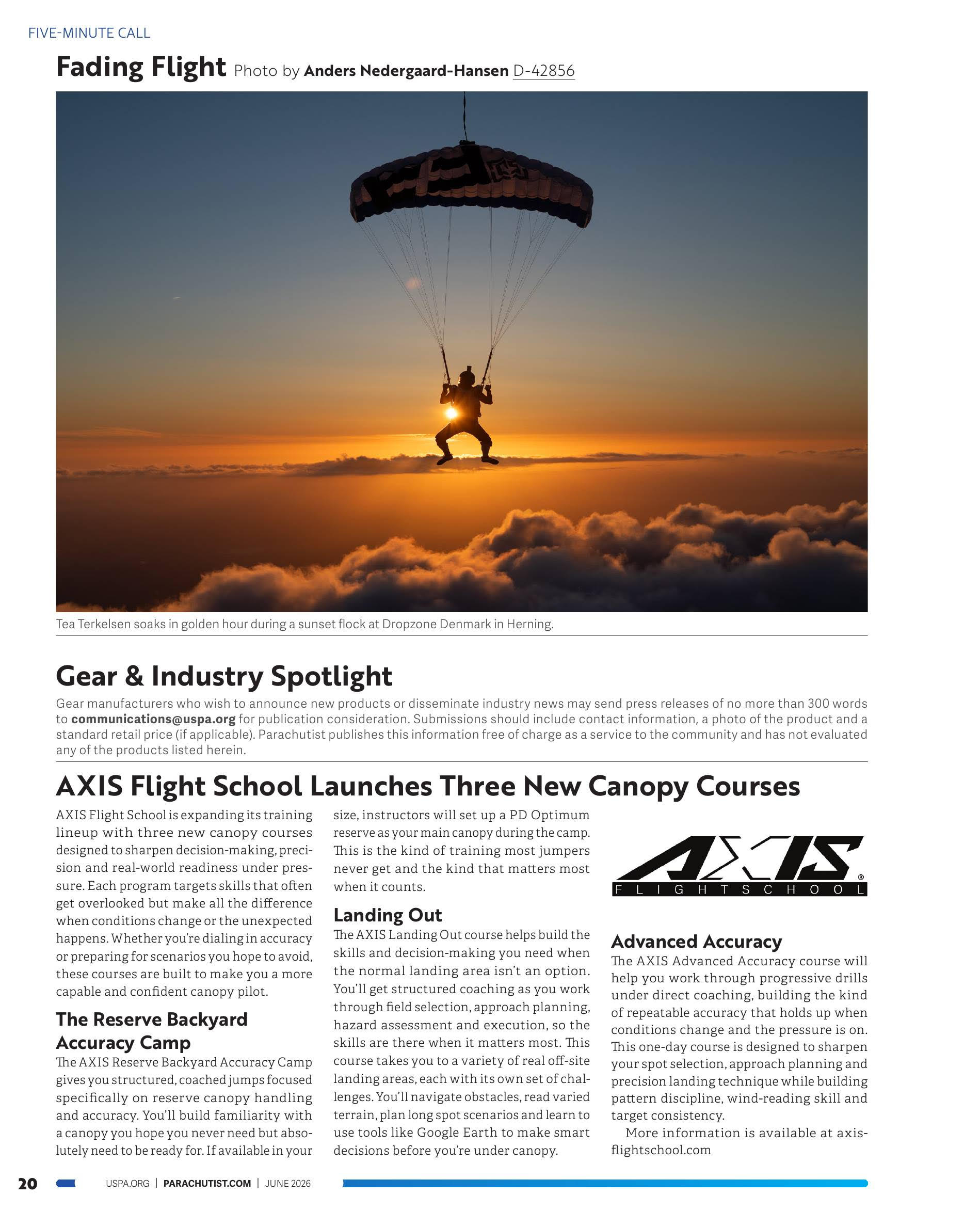
  • AXIS Flight School published its first Foundations of Flight article in Parachutist Magazine back in April of 2011. (Hard to believe, right?!)

    Since then, we’ve used FoF to cover a huge number of freefall and canopy piloting topics, spanning everything from the A-lic fundamentals to the stuff at the pointiest end of the sport. While there have been a few interruptions to the regularly scheduled programming here and there (due to our busy competition schedules, military parachuting training and the other projects we take on), the great feedback encouraged us to consistently contribute to that monthly column for more than a decade.

    We decided to take an extended hiatus two years ago, but popular demand kept getting more and more demanding. Skydivers, as it turns out, love Foundations of Flight. And we, in turn, love skydivers.

    And so—without further ado, it’s back.

    We’re kicking things (back) off by dropping some more canopy knowledge. This new, six-part series—called Approaching with Confidence—is AXIS’ FoF # 126.

    Enjoy!

  • Or: How to read FAI Records, for the Comp-Curious

    A quick guide to understanding current FAI speed skydiving records — what G-1 and G-2 mean, how records are classified, and where AXIS's competition results fit in.
    
    Brianne flying fast over Skydive Arizona. Photo by Niklas Daniel.

    What you’re looking at

    If you’ve ever wondered how official speed skydiving records are tracked and certified, the FAI “at-a-glance” tables offer a fascinating snapshot.

    These tables summarise the current world and continental benchmarks recognised by the Fédération Aéronautique Internationale (FAI) — the governing body for air sports worldwide — as of September 2025, following the Hohenems competition. (In case of any discrepancy, the FAI documentation always prevails.)

    It seems silly to have a Maximum Vertical Speed category that involves the use of a drogue, however at extemly high altitudes the air is so thin that maintaining stablity is a serious safety concern – but I digress.

    How to read the table

    FAI records in speed skydiving fall into two main categories, known as G-1 and G-2.

    CategoryMeaningType of Record
    G-1 (Competition)Recognised during sanctioned competitions, using strict format and altitude limits (typically ≤ 14,000 ft AGL).Average of the athlete’s three fastest consecutive seconds during a dive.
    G-2 (Performance)Recognises absolute or experimental achievements, often outside standard competition format.May include special equipment or extreme altitudes — for example, Felix Baumgartner’s 1,357.6 km/h Red Bull Stratos jump (2012).

    Each category is then divided into classes — Open, Female, Junior Male, Junior Female, National Team, and Mixed Team — and tracked at World, Continental, and Regional levels.


    Speed Skydivers cannot use propulsion systems or carry additional weights during competition.

    Why the results table is useful

    For those following the evolution of speed skydiving, these summaries provide:

    • Context: How world, continental, and national results compare.
    • Progress tracking: Where recent competitions have pushed the limits.
    • Motivation: Benchmarks for current and aspiring competitors.

    It’s also a reminder that speed skydiving is not only about raw numbers — it’s about discipline, repeatability, and documentation.

    The current snapshot (September 2025)

    Highlights from the most recent FAI data:

    • World record (G-1 General): 539.51 km/h
    • World record (Female): 497.80 km/h
    • North American record (G-1 General): 528.54 km/h
    • World performance record (G-2): 1,357.6 km/h (Felix Baumgartner, 2012)

    On ratification

    Not every lightning-fast competition run becomes an official record — even when the data proves it happened. Weird, but true. Here’s why.

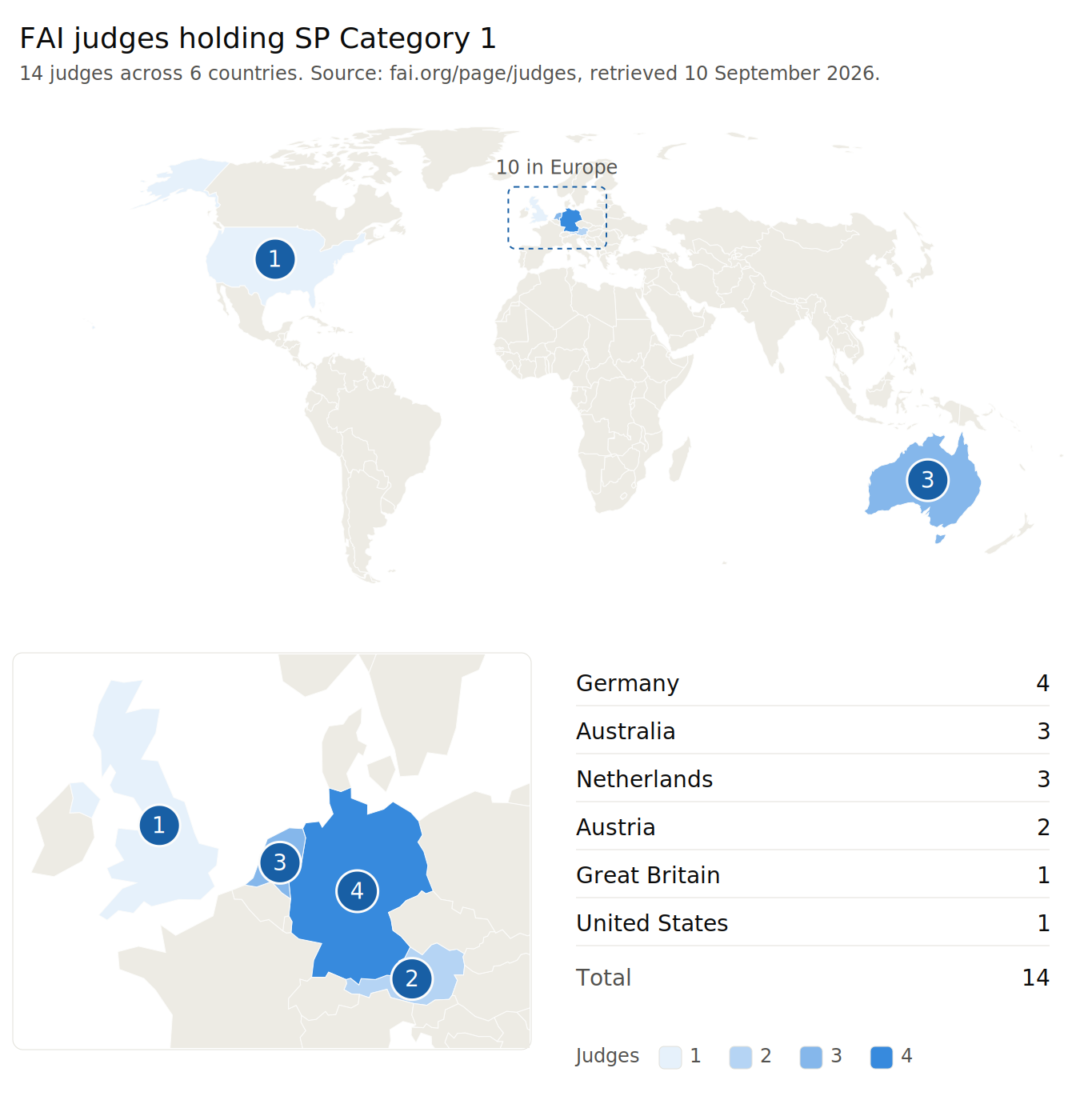
    In speed skydiving, a result can only be ratified by the Fédération Aéronautique Internationale (FAI) if every element of the event meets strict certification standards. That includes not only properly calibrated instrumentation, but also the accreditation level of the judges overseeing the meet.

    In some cases, that last point can make the difference between a record being celebrated on paper…or remaining an unofficial personal best, which is great, but not the best outcome for those of us who pour our hearts and souls into this.

    For example, several of Niklas Daniel’s fastest competition runs exceeded the speeds currently listed in the FAI tables, but couldn’t be ratified because the judging panel at those events didn’t hold a high enough rating under FAI rules.

    Highest Overall Average Speed 527.05 km/h, i.e. average speed over all 8 competition rounds.
    Highest Average Speed 535.23 km/h, i.e. single fastest round.

    It’s a subtle — and sometimes frustrating — aspect of the sport. But it’s also what makes official records meaningful: they represent not just raw performance, but verified precision under fully standardised conditions.

    But hey. There’s always next year.


    Looking ahead

    With record-level speeds now exceeding 530 km/h in competition and new technology improving data accuracy each year, the coming seasons promise even faster verified results.

    Nik’s 2025 takeaway sums it up perfectly:

    “There’s always next year.”


    ✅ Curious about speed skydiving training or competition prep?

    Train with us at AXIS Flight School to learn how to fly efficiently, track your data, and push your own envelope safely.