AXIS Flight School offers structured, progressive training designed to help sport skydivers of all levels achieve their personal and competitive goals. Whether you’re looking to improve your canopy skills, master new freefall techniques in the tunnel and sky, or prepare for competition, our world-class coaches will guide you every step of the way.
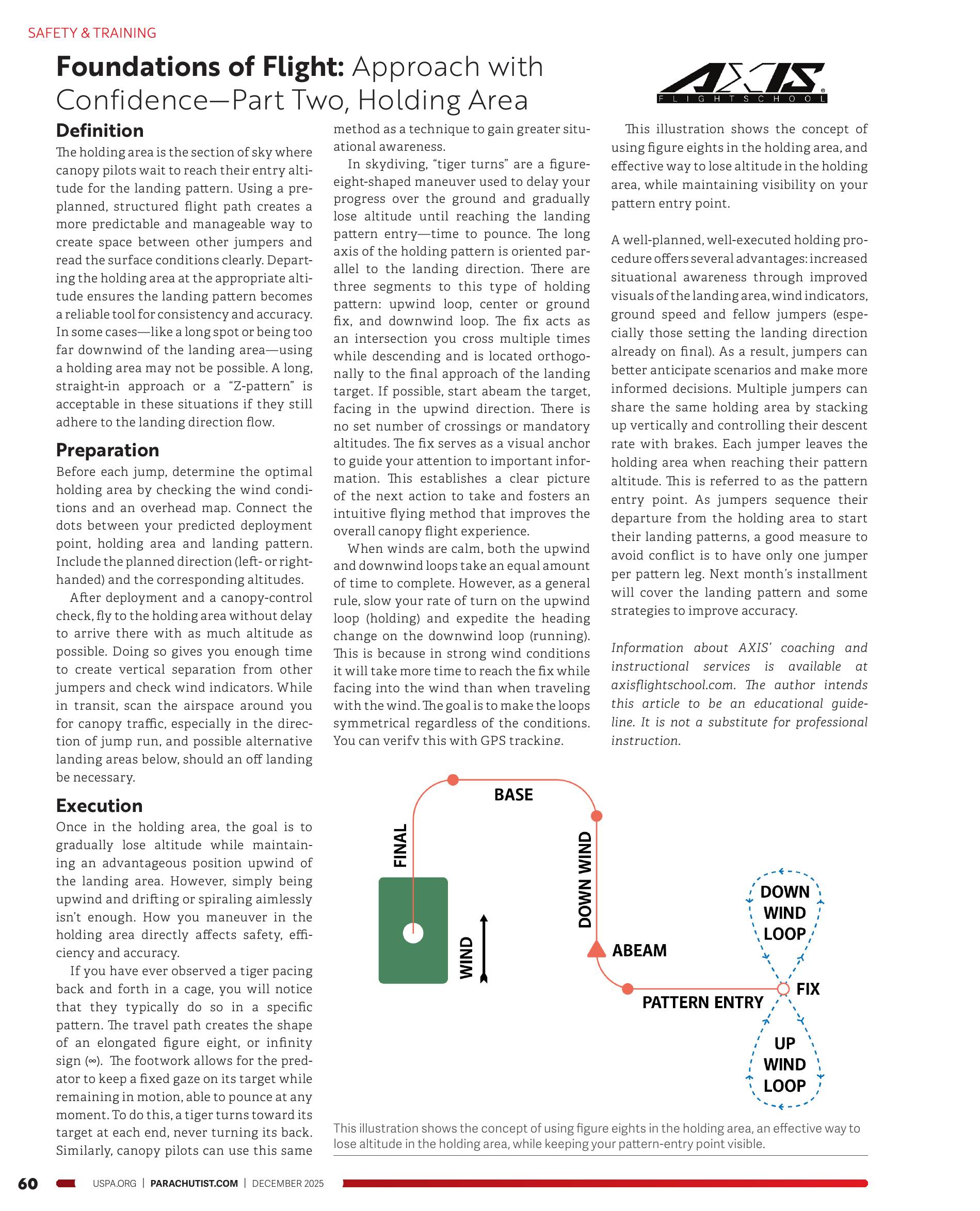
Our friends in Ol’ Blighty invited us to share our work on slow flight (previously published by Parachutist on this side of the pond), and we were glad to oblige. We’re pretty pleased with how it came out!
The ISSA World Cup Series 2025 brought together over 61 competitorsfrom 12 countries facing off across three continents in eight high-speed events to determine the world’s top speed skydivers.
The ISSA World Series 2025 consisted of 8 separate meets, with the season culminating in Eloy, Arizona, with the eighth and final event hosted by AXIS Flight School at Skydive Arizona. This past weekend, 15 competitors from the United States and Europe met in Eloy for the final showdown.
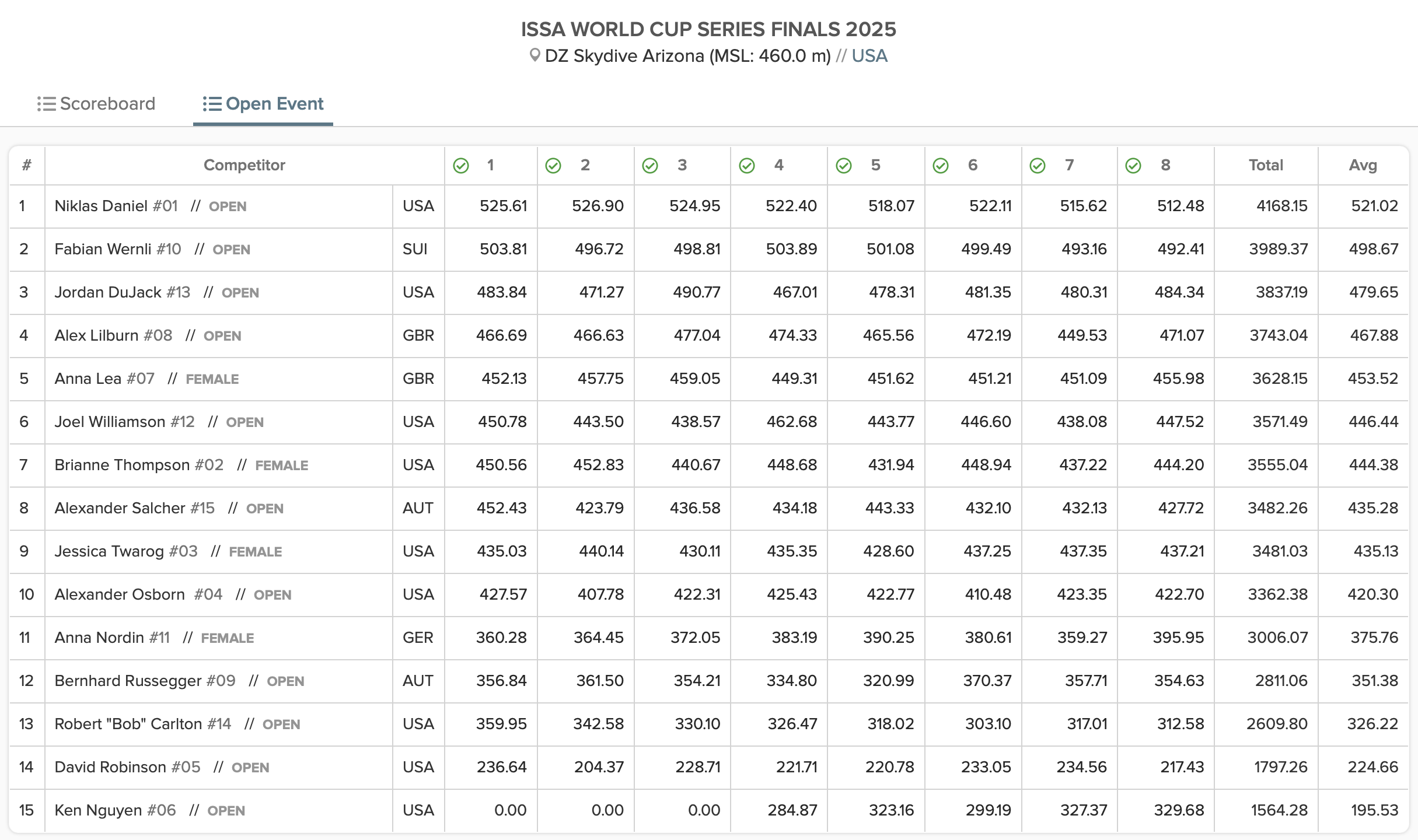
In the open event at Eloy, Niklas Daniel (USA) claimed victory with another superb performance across eight rounds, posting an average speed of 521.02 km/h. Fabian Wernli (SUI) secured second place, while Jordan DuJack (USA) rounded out the podium in third.
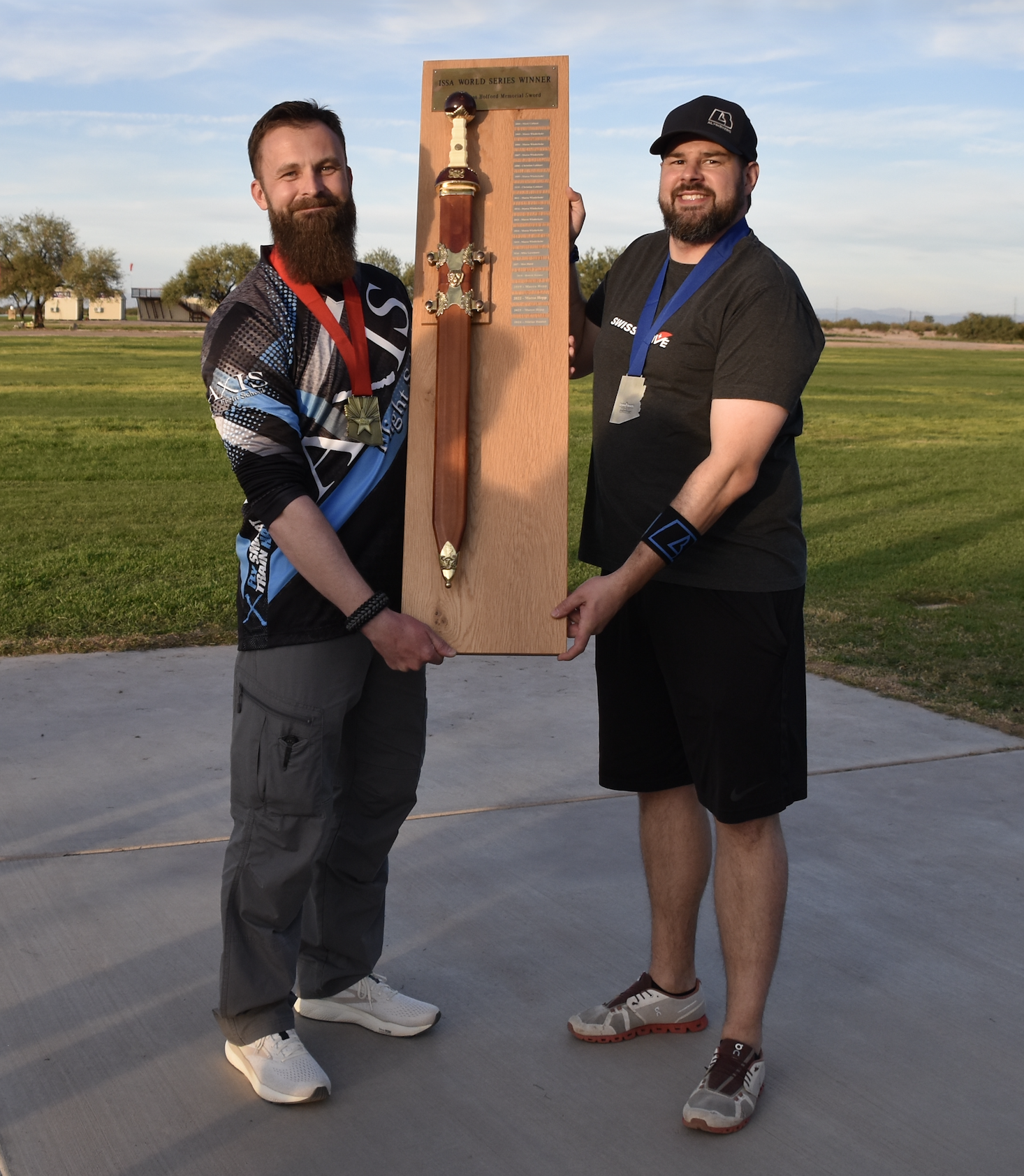
Niklas Daniel receives the ISSA Trophy from ISSA representative Fabrian Wernli.
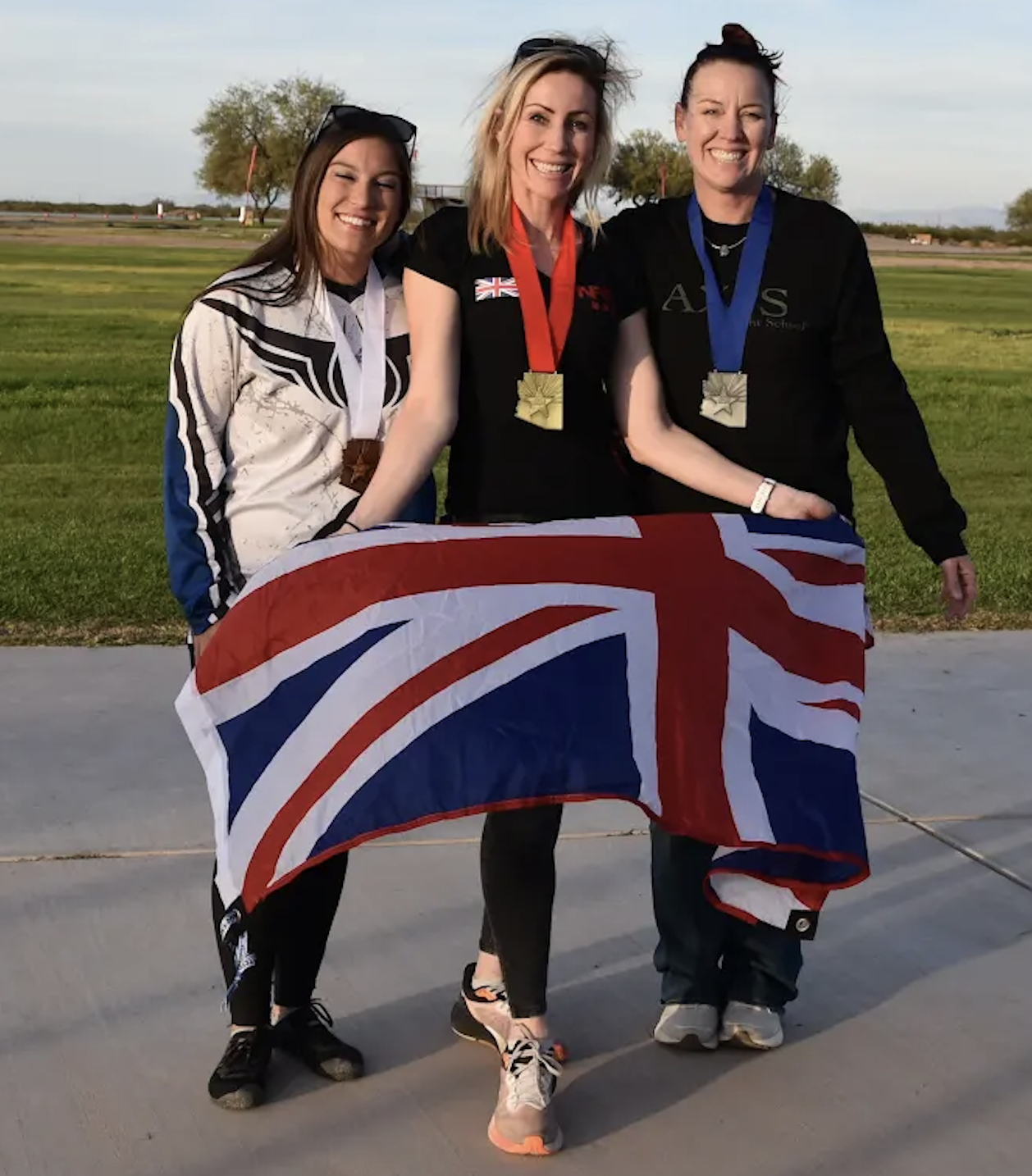
In the female class, Anna Lea (GBR) dominated with a remarkable average speed of 453.52 km/h. Brianne Thompson (USA) took second place, followed by Jessica Twarog (USA) in third.
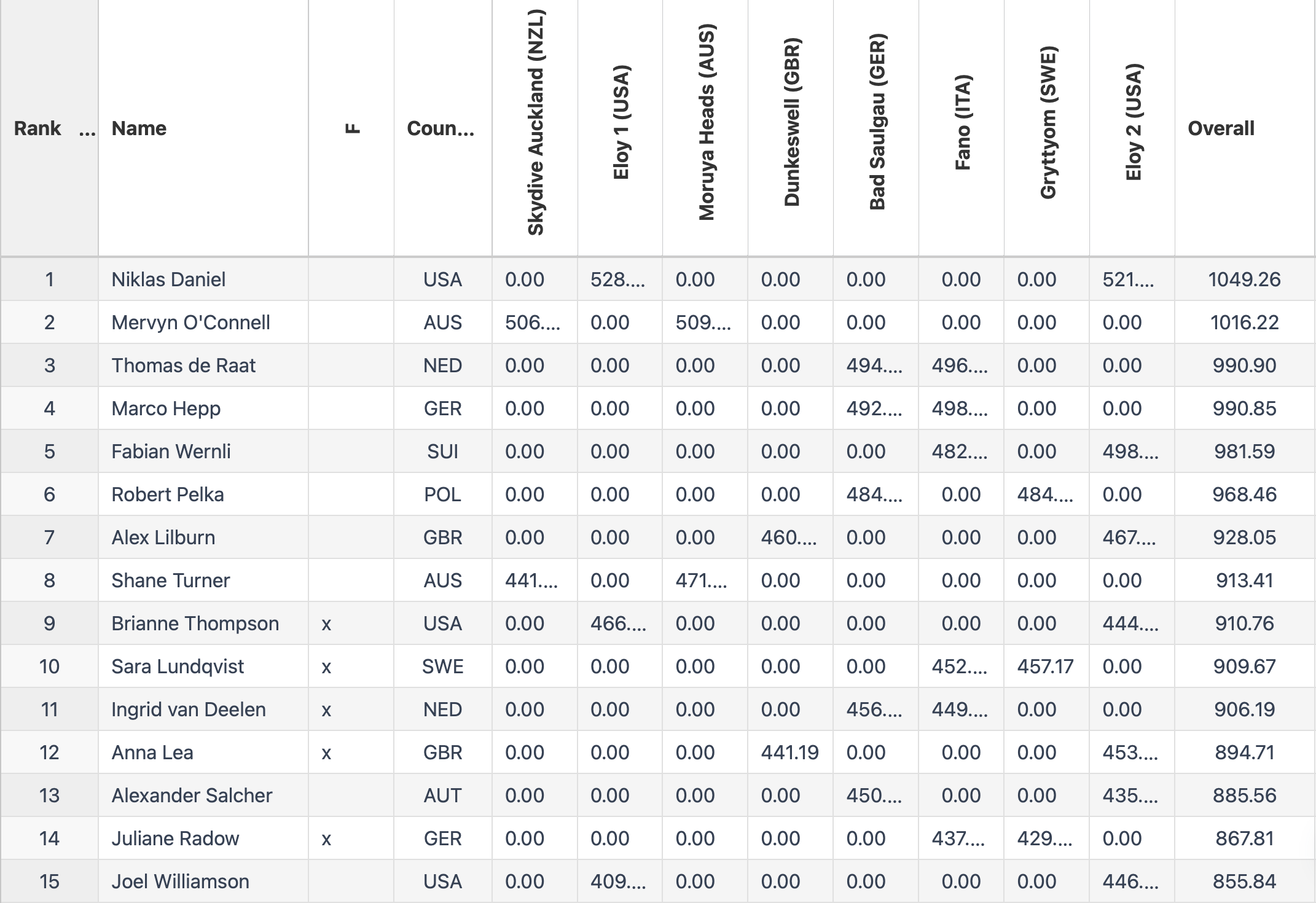
In the overall winners 2025 standings, competing the World Cup Series Finals on their home base gave Niklas Daniel and Brianne Thompson a strong motivational boost. Niklas took the lead with his excellent performance, finishing ahead of Mervin O’Connel (AUS). The competition for third place was extremely close, with Thomas de Raat (NED) securing the spot by just 0.5 points in front of Marco Hepp (GER).
Brianne also delivered in the final, winning the overall women’s standings ahead of Sara Lundqvist (SWE) and Ingrid van Deelen (NED). Just 4.5 points separated first and third place.
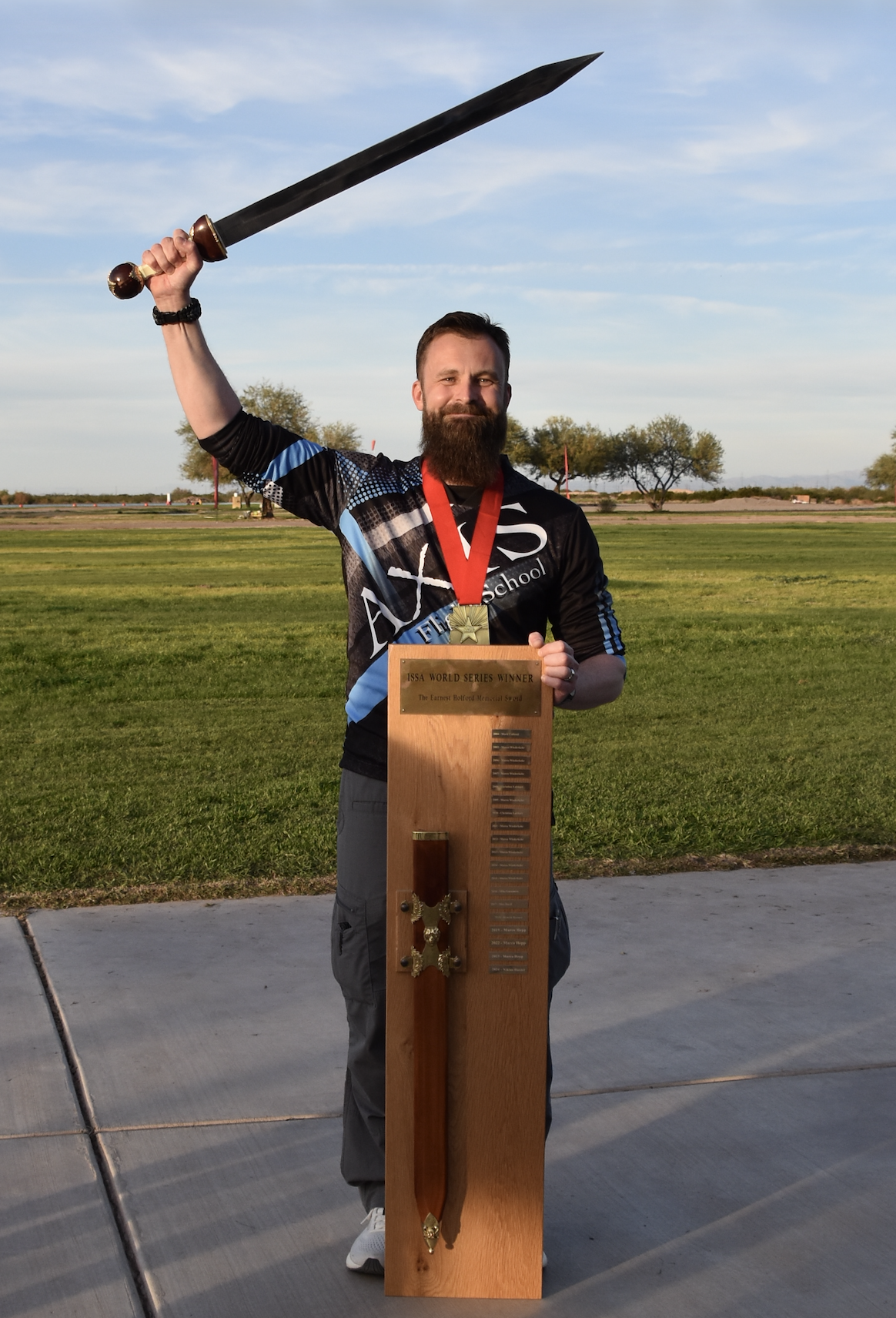
This is AXIS Flight School’s Niklas Daniel second consecutive ISSA World Cup Series Title. Current FAI World Champion and 2024 ISSA World Cup Champion Niklas Daniel was able to defend possession of the ISSA Earnest Holford Memorial Sword and will get to keep it for another year. Niklas Daniel receives the ISSA Trophy from ISSA representative Fabian Wernli.
🤔 How the World Series scoring works: Wherever a competitor did not participate in an event, the result for that meet(s) is zero. The World Series overall result is the sum of the two best meet results for each competitor regardless of the number of events completed (points per meet = meet result of a single meet). At the completion of the series, the competitor with the most points at the end of the year is declared the ISSA Speed Skydiving World Cup Series Champion 2025.
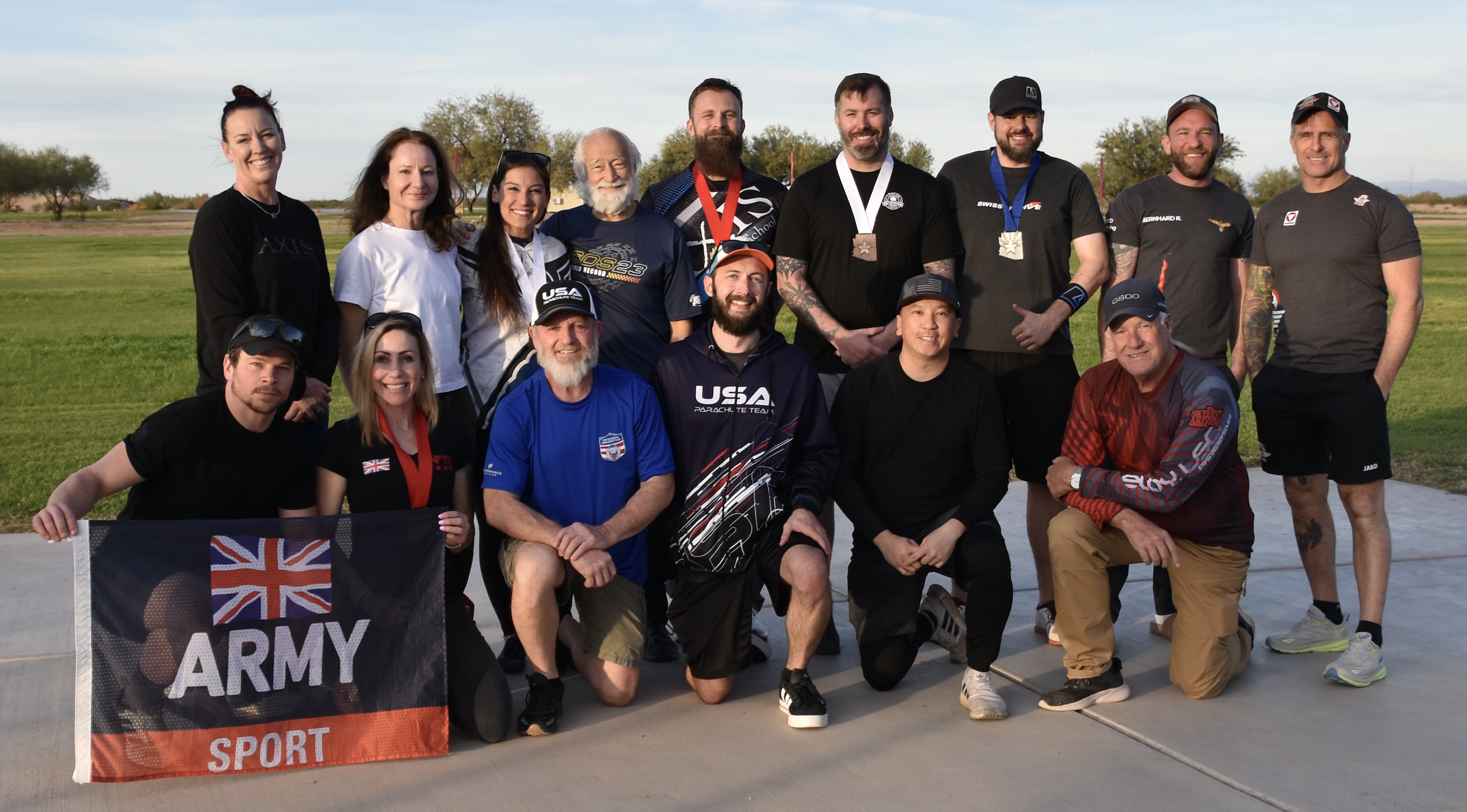
Top left to right: Brianne Thompson, Anna Nordin, Jessica Twarog, David Robinson, Niklas Daniel, Jordan DuJack, Fabian Wernli, Bernhard Russegger, Alexander Salcher. Bottom left to right: Alex Lilburn, Anna Lea, Joel WIlliamson, Alexander Osborn, Ken Nguyen, Robert “Bob” Carlton. Photo by Kay Robinson at Skydive Arizona.
Over the weekend, 14 competitors gave it everything they had, chasing one simple goal: fly as fast as humanly possible.
👉 Competitor Snapshot 👈 11x male | 4x female 5x nationalities 4x competitors in their 30s; 6x in their 40s; 1x in their 50s; 2x in their 60s; 1x in their 70s
Many athletes set new personal bests, updating their Eternal Rankings. We also welcomed a couple of newcomers to the discipline: Ken and David.
Speed Skydiving keeps getting stronger every year. Word on the street is that 2026 will see 3 ISSA events in the USA alone. There is also growing desire for USPA and FAI to adopt a Masters Class, especially given that 4 competitors were over the age of 50 at the Eloy meet alone. The Junior category (24 years of age or younger) has been a staple for many years now.
Special thanks to Michael at Flysight for providing the competition units.
And thank you to every competitor, especially those who traveled here from the other side of the globe. The sportsmanship and camaraderie were unmistakable all weekend.
Special thanks as well to the Skydive Arizona staff and pilots who made this event possible. Training for and participating in ISSA events is a great way to learn and get exposure to Speed Skydiving. For information about future events and coaching, visit www.AXISFlightSchool.com
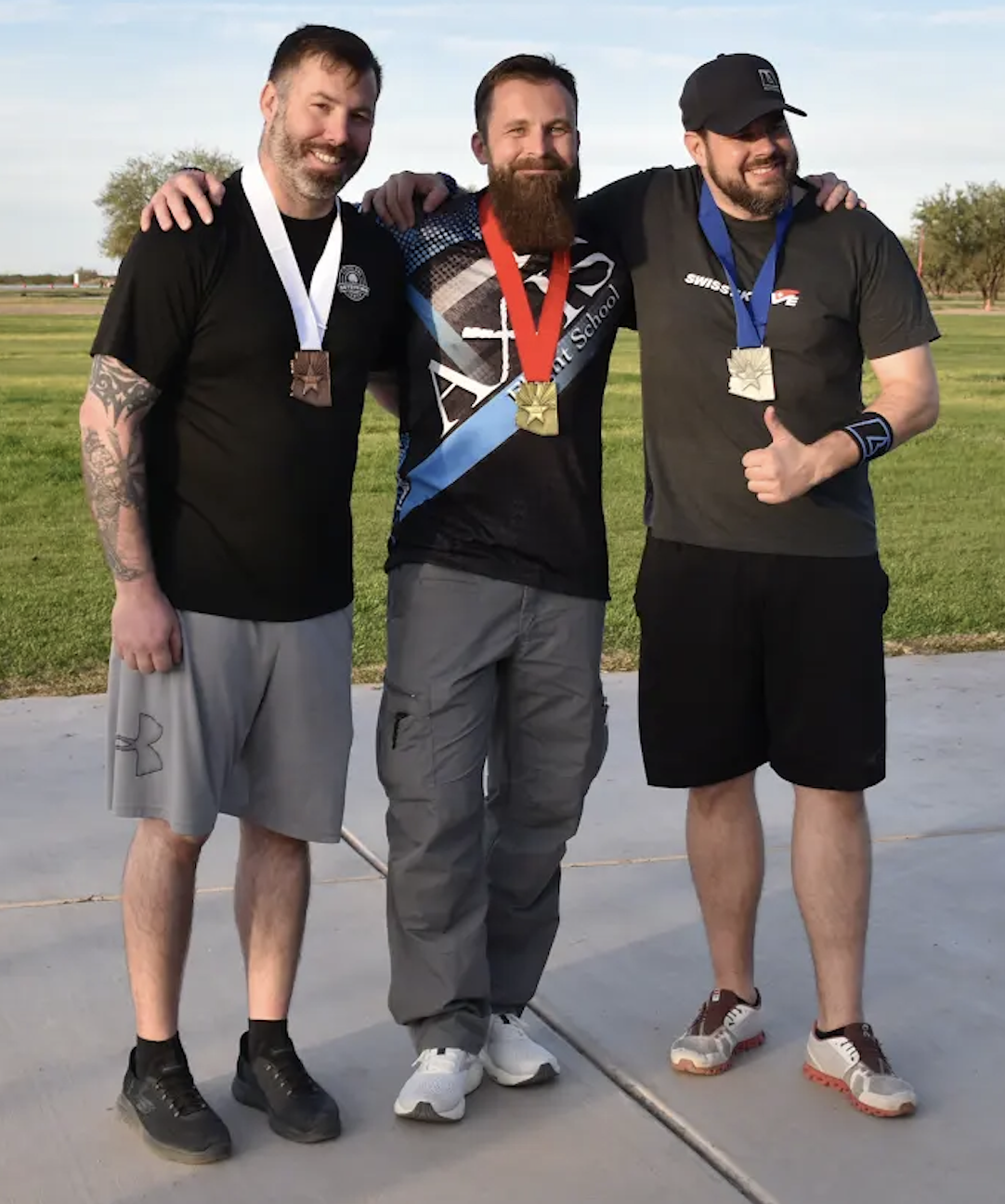
Open: (3) Jordan DuJack, (1) Niklas Daniel, (2) Fabian Wernli. Photo by Kay Robinson. Female: (3) Jessica Twarog, (1) Anna Lea, (2) Brianne Thompson. Photo by Kay Robinson.
Since then, we’ve used FoF to cover a huge number of freefall and canopy piloting topics, spanning everything from the A-lic fundamentals to the stuff at the pointiest end of the sport. While there have been a few interruptions to the regularly scheduled programming here and there (due to our busy competition schedules, military parachuting training and the other projects we take on), the great feedback encouraged us to consistently contribute to that monthly column for more than a decade.
We decided to take an extended hiatus two years ago, but popular demand kept getting more and more demanding. Skydivers, as it turns out, love Foundations of Flight. And we, in turn, love skydivers.
And so—without further ado, it’s back.
We’re kicking things (back) off by dropping some more canopy knowledge. This new, six-part series—called Approaching with Confidence—is AXIS’ FoF # 126.
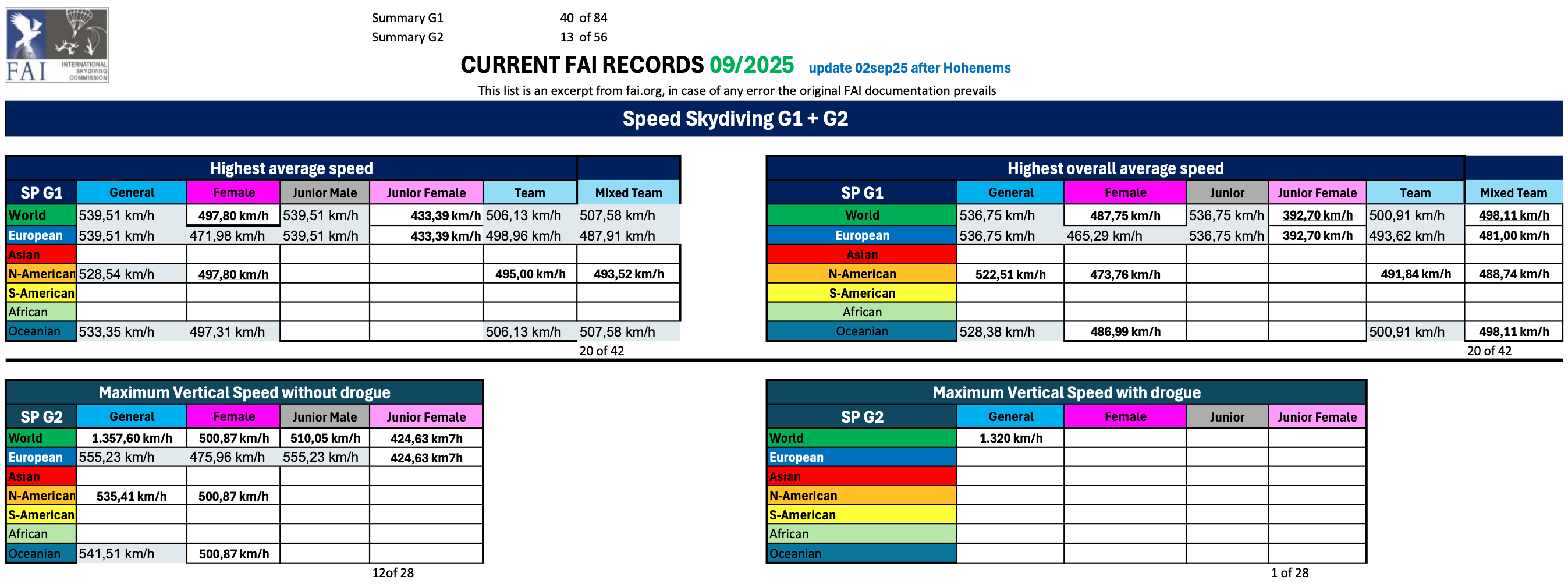
A quick guide to understanding current FAI speed skydiving records — what G-1 and G-2 mean, how records are classified, and where AXIS's competition results fit in.
Brianne flying fast over Skydive Arizona. Photo by Niklas Daniel.
What you’re looking at
If you’ve ever wondered how official speed skydiving records are tracked and certified, the FAI “at-a-glance” tables offer a fascinating snapshot.
These tables summarise the current world and continental benchmarks recognised by the Fédération Aéronautique Internationale (FAI) — the governing body for air sports worldwide — as of September 2025, following the Hohenems competition. (In case of any discrepancy, the FAI documentation always prevails.)
It seems silly to have a Maximum Vertical Speed category that involves the use of a drogue, however at extemly high altitudes the air is so thin that maintaining stablity is a serious safety concern – but I digress.
How to read the table
FAI records in speed skydiving fall into two main categories, known as G-1 and G-2.
Category
Meaning
Type of Record
G-1 (Competition)
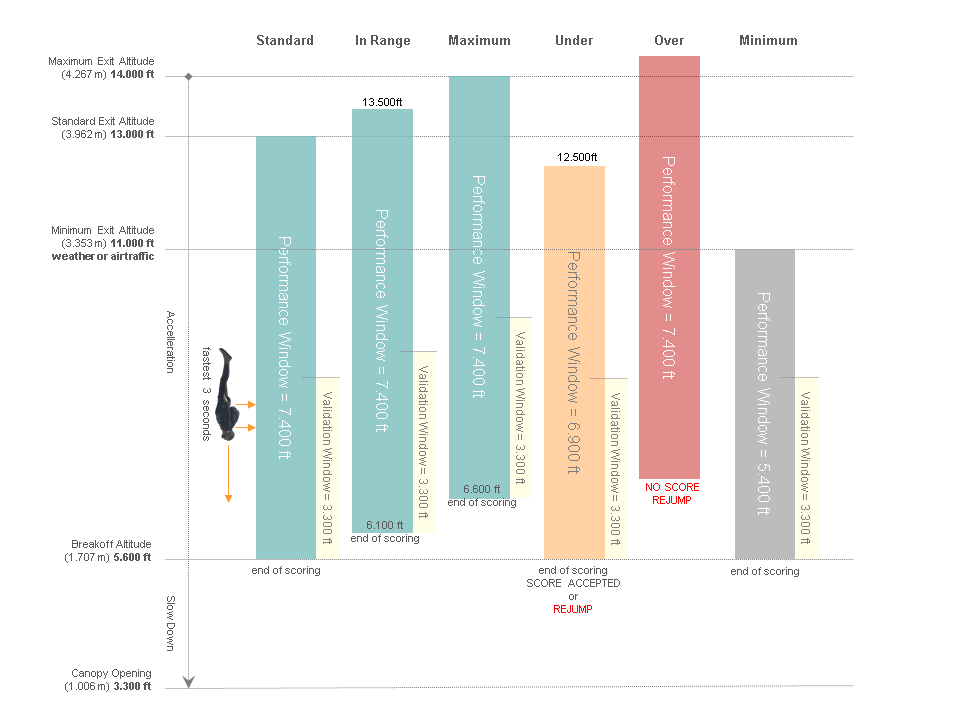
Recognised during sanctioned competitions, using strict format and altitude limits (typically ≤ 14,000 ft AGL).
Average of the athlete’s three fastest consecutive seconds during a dive.
G-2 (Performance)
Recognises absolute or experimental achievements, often outside standard competition format.
May include special equipment or extreme altitudes — for example, Felix Baumgartner’s 1,357.6 km/h Red Bull Stratos jump (2012).
Each category is then divided into classes — Open, Female, Junior Male, Junior Female, National Team, and Mixed Team — and tracked at World, Continental, and Regional levels.
Speed Skydivers cannot use propulsion systems or carry additional weights during competition.
Why the results table is useful
For those following the evolution of speed skydiving, these summaries provide:
Context: How world, continental, and national results compare.
Progress tracking: Where recent competitions have pushed the limits.
Motivation: Benchmarks for current and aspiring competitors.
It’s also a reminder that speed skydiving is not only about raw numbers — it’s about discipline, repeatability, and documentation.
The current snapshot (September 2025)
Highlights from the most recent FAI data:
World record (G-1 General): 539.51 km/h
World record (Female): 497.80 km/h
North American record (G-1 General): 528.54 km/h
World performance record (G-2): 1,357.6 km/h (Felix Baumgartner, 2012)
On ratification
Not every lightning-fast competition run becomes an official record — even when the data proves it happened. Weird, but true. Here’s why.
In speed skydiving, a result can only be ratified by the Fédération Aéronautique Internationale (FAI) if every element of the event meets strict certification standards. That includes not only properly calibrated instrumentation, but also the accreditation level of the judges overseeing the meet.
In some cases, that last point can make the difference between a record being celebrated on paper…or remaining an unofficial personal best, which is great, but not the best outcome for those of us who pour our hearts and souls into this.
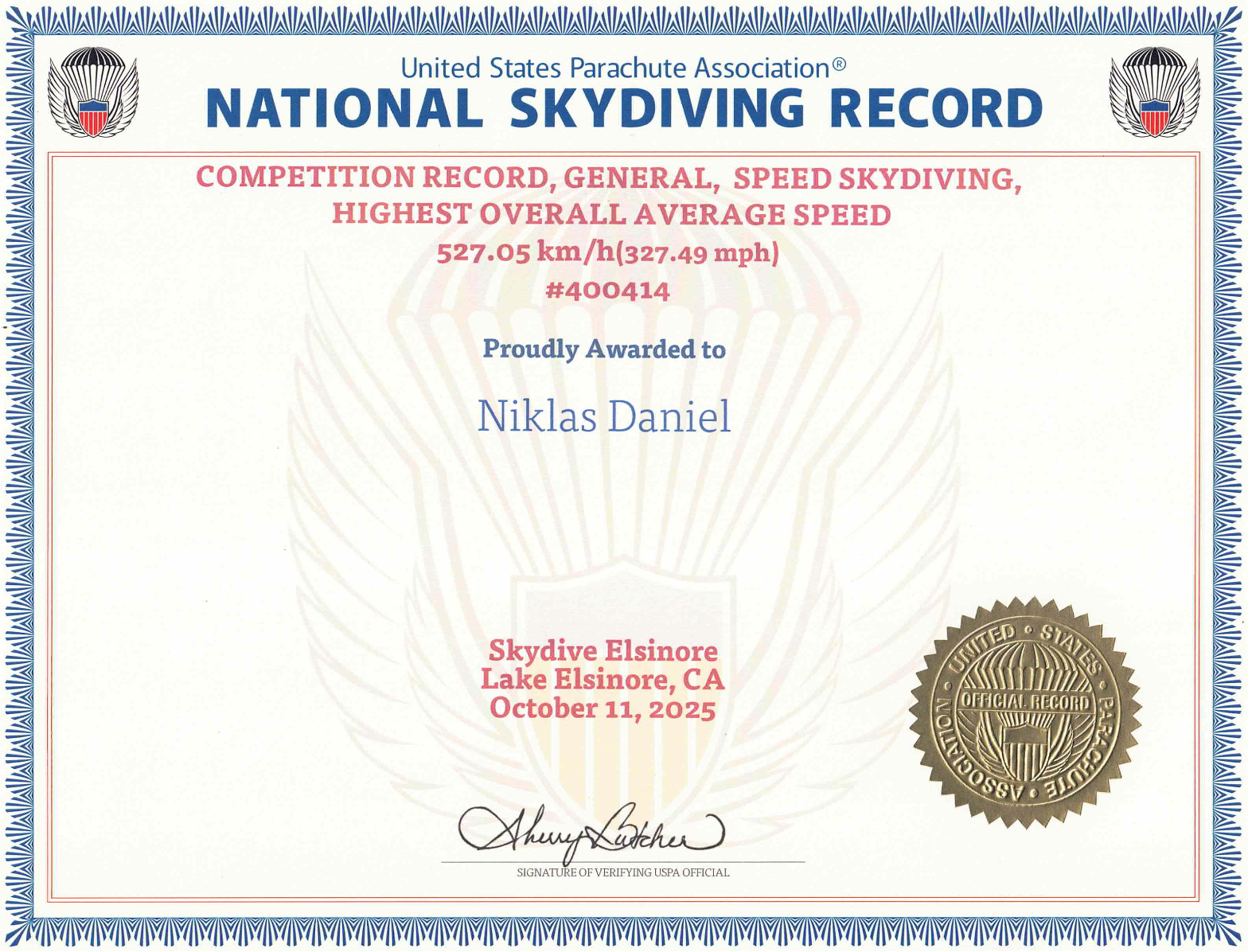
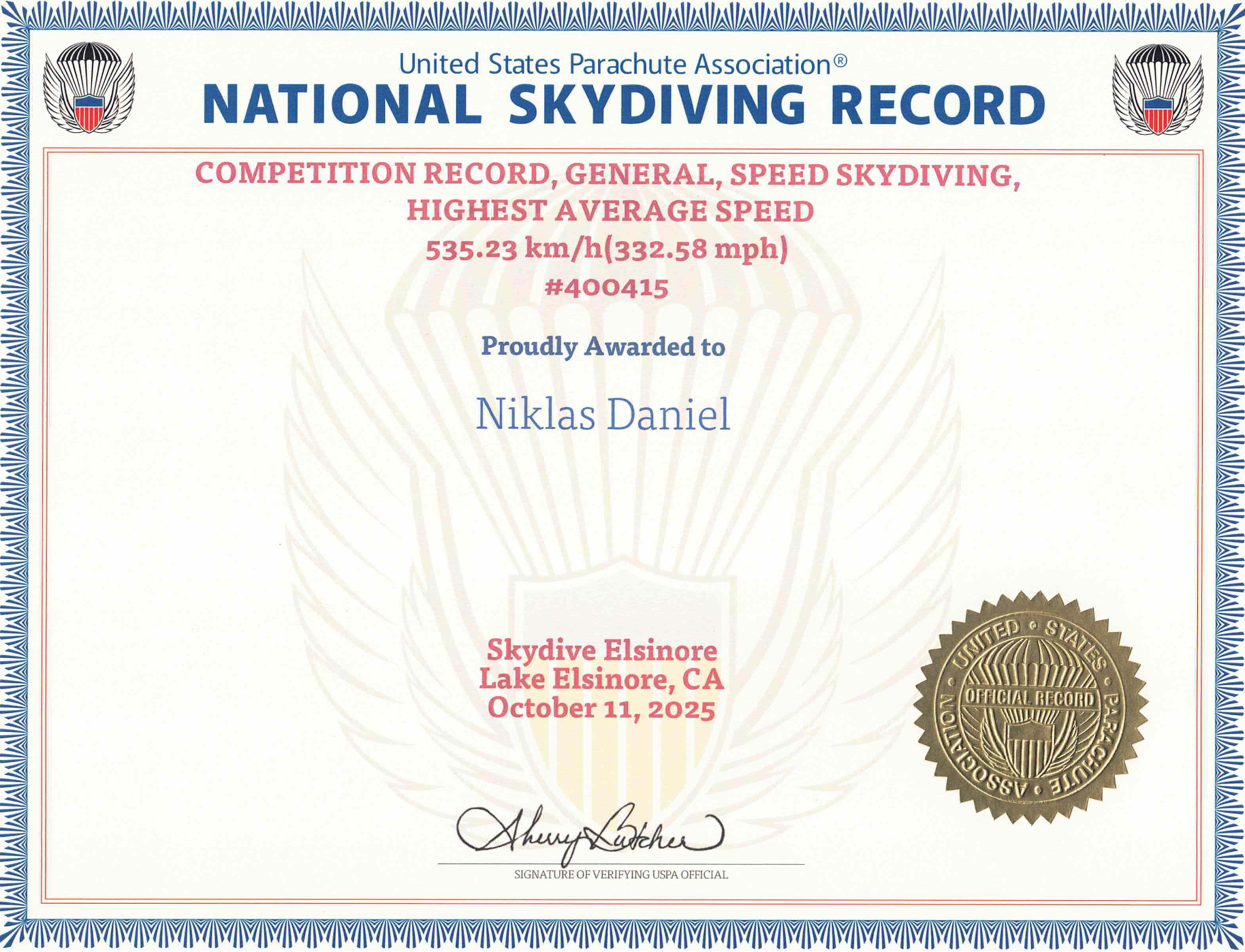
For example, several of Niklas Daniel’s fastest competition runs exceeded the speeds currently listed in the FAI tables, but couldn’t be ratified because the judging panel at those events didn’t hold a high enough rating under FAI rules.
Highest Overall Average Speed 527.05 km/h, i.e. average speed over all 8 competition rounds. Highest Average Speed 535.23 km/h, i.e. single fastest round.
It’s a subtle — and sometimes frustrating — aspect of the sport. But it’s also what makes official records meaningful: they represent not just raw performance, but verified precision under fully standardised conditions.
But hey. There’s always next year.
Looking ahead
With record-level speeds now exceeding 530 km/h in competition and new technology improving data accuracy each year, the coming seasons promise even faster verified results.
Nik’s 2025 takeaway sums it up perfectly:
“There’s always next year.”
✅ Curious about speed skydiving training or competition prep?
Train with us at AXIS Flight School to learn how to fly efficiently, track your data, and push your own envelope safely.
Wind tunnel time improves balance, control, and safety for speed skydivers. Here’s why training slow helps you fly fast.
Body-flight is balance in motion
Body-flight, in all its forms, is a study in balance. By fine-tuning the drag forces around their centre of mass, a flyer can maintain control and maneuver efficiently through the relative wind. The better your balance, the less likely you are to go unstable during a high speed dive. Your corrections along the way are also going to be more refined as not to over or under correct.
This balance becomes especially critical in speed skydiving, where the goal is to descend as fast as possible—safely, so you can, you know, do it again.
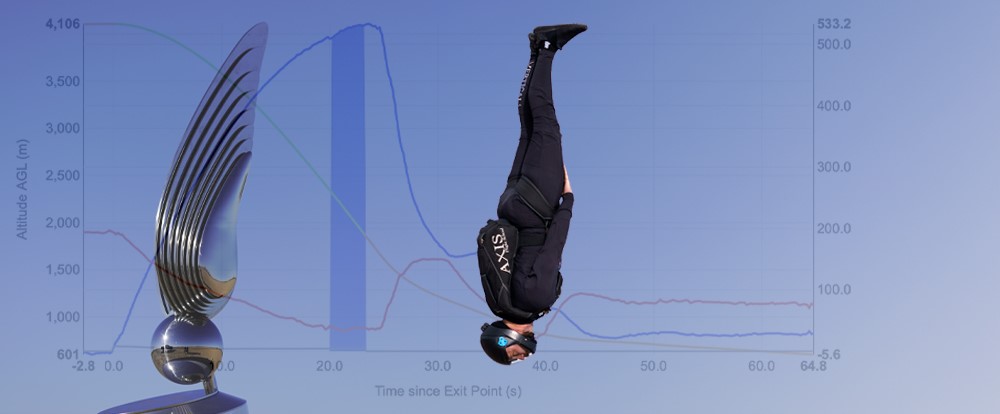
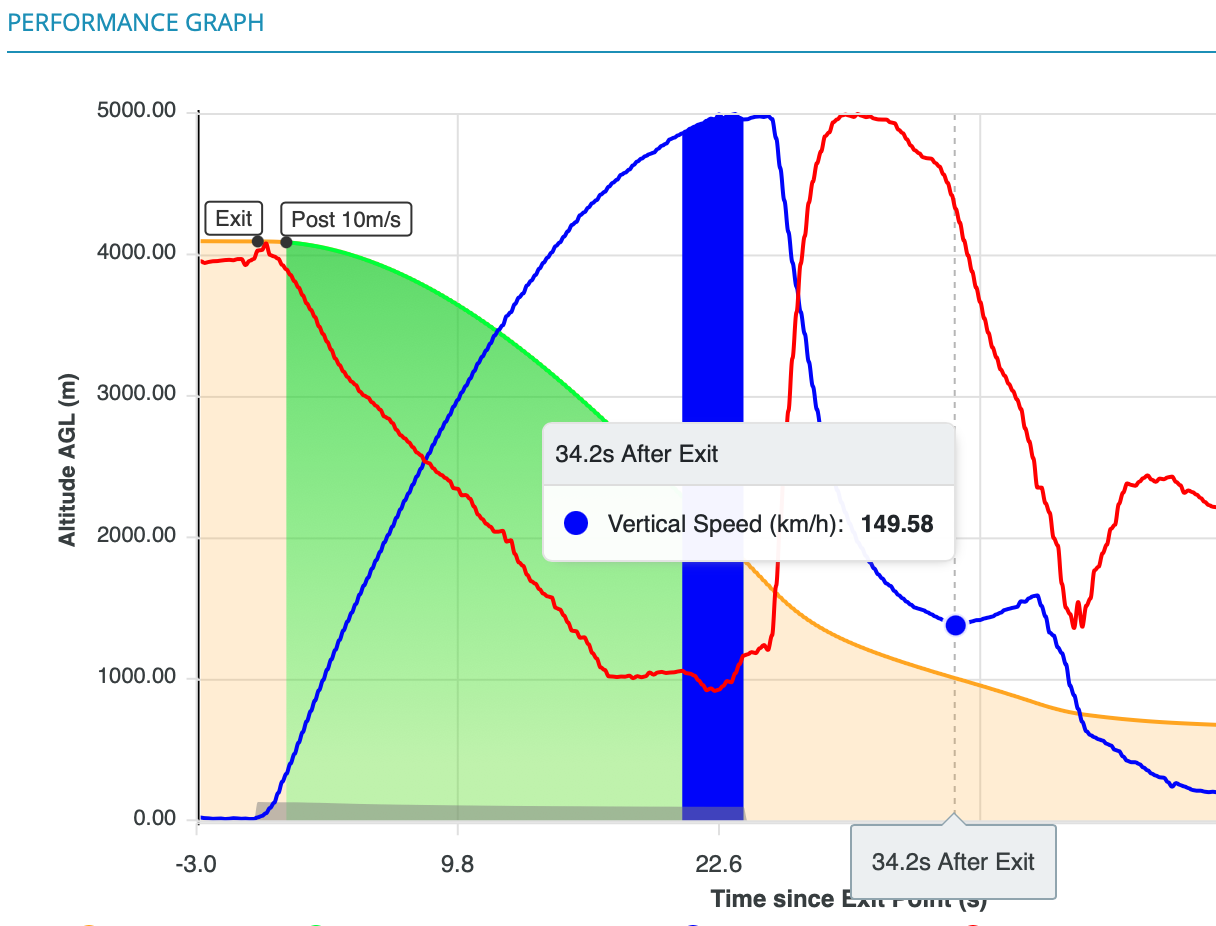
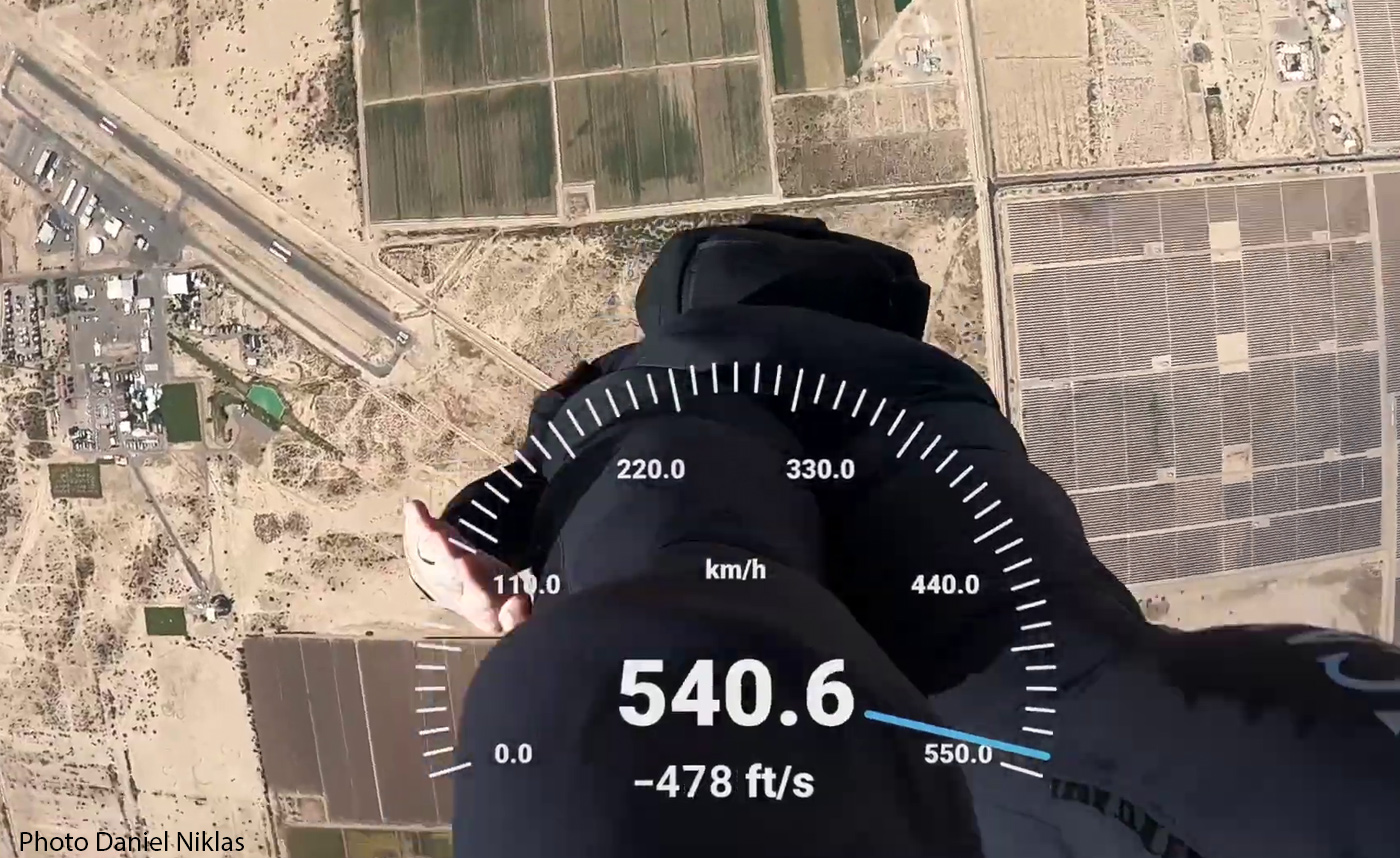
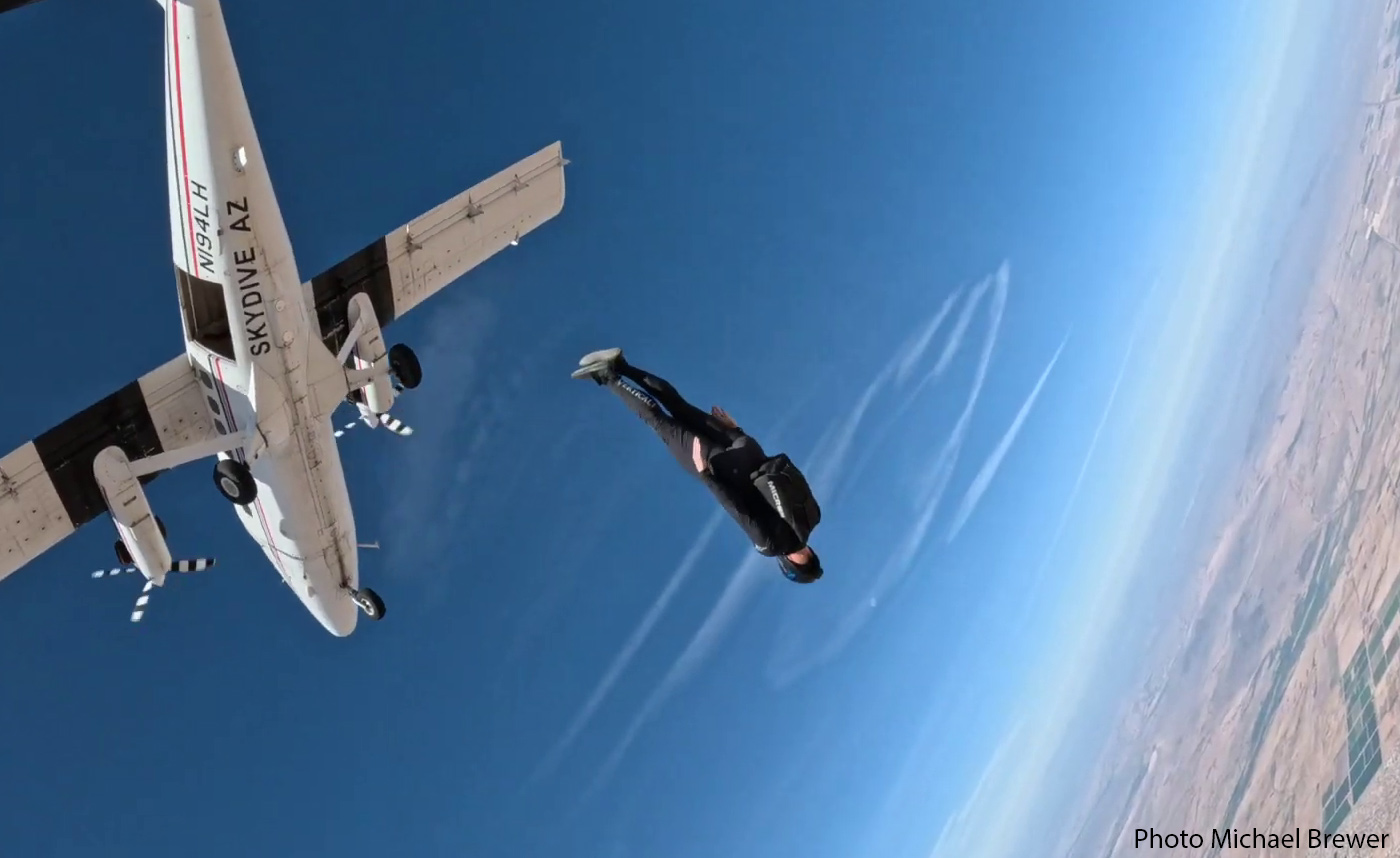
During the 2025 USPA National Speed Skydiving Championships, AXIS Flight School’s Niklas Daniel reached an incredible top speed of 544.25 km/h — 338.18 mph. As Nik transitions out of his dive and prepares for parachute deployment, his vertical descent frequently slows to 150kmh (93mph) or less. That is significantly slower than the average belly to earth skydiver who fall at around 120mph – keep in mind Nik does this in a skin tight suit which offers little air resistance. That’s a fall rate range of nearly 395 km/h (245 mph) within a single jump.
149.58 km/h (92.95 mph).
Managing that range isn’t just about performance. It’s about safety. The smoother and slower the transition into deployment, the less stress is placed on both the body and the equipment.
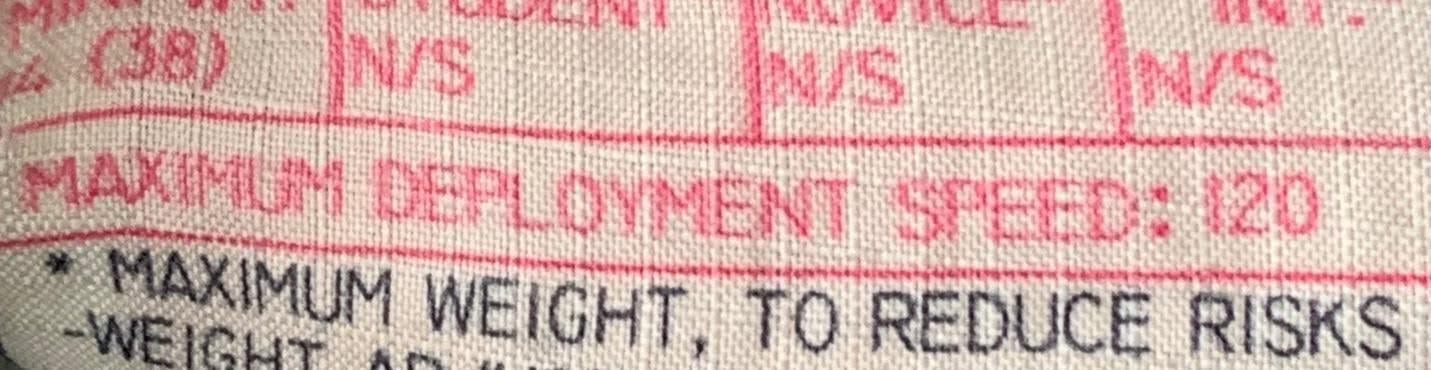
⚠️ Hey! Check the warning label on the top skin near your canopy’s tail for your parachute’s Skill and Operating Limits. Aim to keep your deployment speed at or below 120 knots (222 km/h / 138 mph)—a key benchmark for safe openings.
Why wind tunnel training still matters for speed skydivers
Vertical wind tunnels can’t replicate the full conditions of a 350 mph dive—most top out at 180 mph. Even if a tunnel could produce higher speeds, it is unlikely that a facility would allow a human to fly in such fast airflow; a minor wobble at that velocity could send a flyer slamming into a wall or ceiling.
But that doesn’t mean that your tunnel time is wasted. Quite the opposite, as a matter of fact.
For speed skydivers, the tunnel offers a controlled environment to refine foundational skills that directly translate to sky performance.
Key tunnel skills for speed skydivers
Slow belly flight: Build stability and awareness at lower fall rates—vital for smooth, low-stress deployments.
Back-flying and barrel rolls: Develop recovery skills to regain control after instability.
Air awareness: Long tunnel sessions sharpen sensory feedback and balance—the foundation of efficient flight.
With professional coaching, flyers can fine-tune these control skills and expand their overall flight envelope, gaining the body intelligence that separates good flyers from great ones.
What the tunnel can’t teach you
The tunnel can’t reproduce:
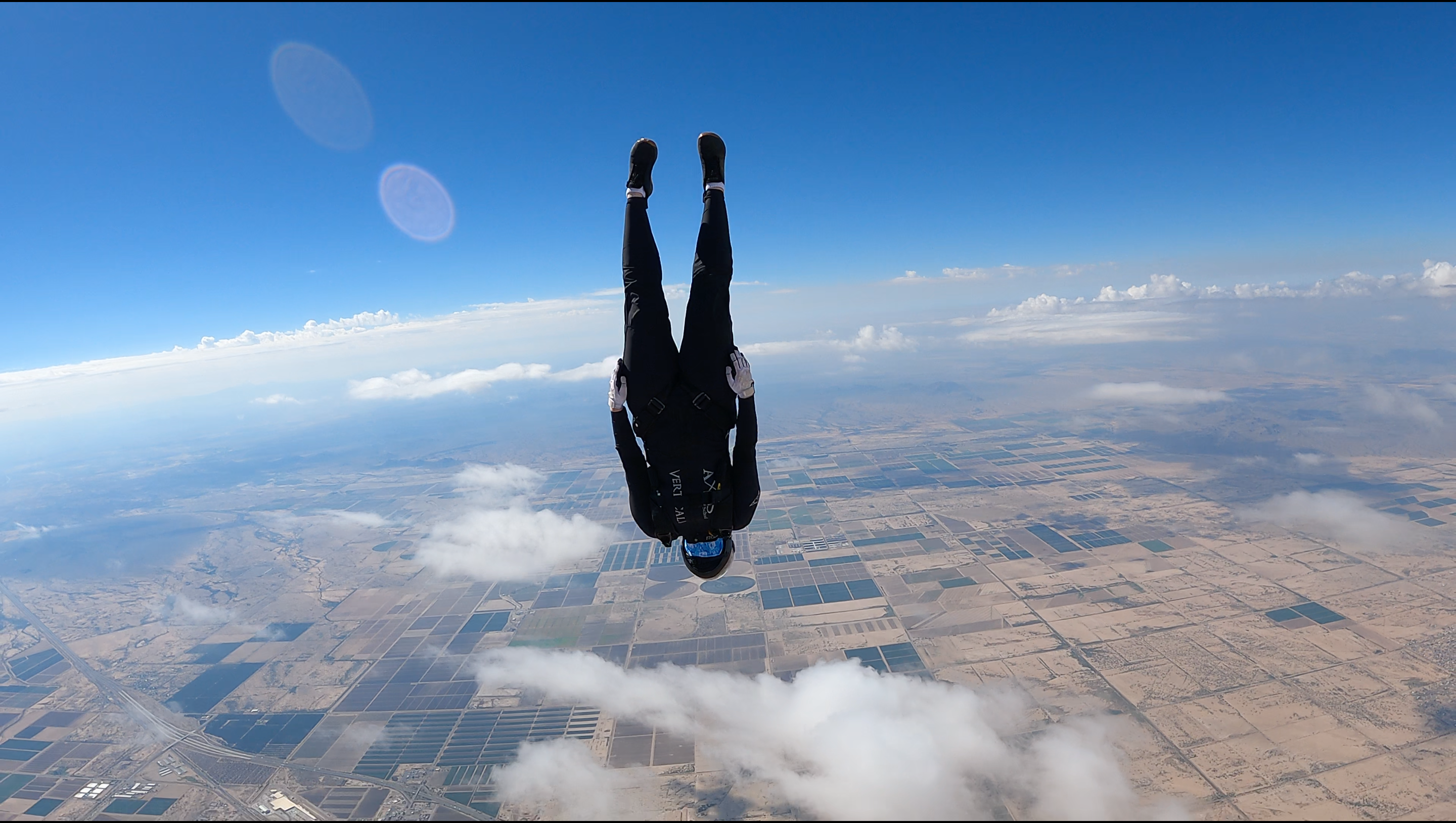
The exit presentation and flying the hill during the initial acceleration phase of a speed dive.
The aerodynamic forces beyond 200 mph that require quick and acurate reflexes to maintain control.
Even so, coupling tunnel work with tracking and angle-flying practice gives skydivers a rounded skill set for entering the speed discipline confidently.
The takeaway
Wind tunnel training won’t make you a speed champion on its own—but it will make you a smarter, safer, and more adaptable flyer.
Mastering control at both ends of your fall-rate range is key to flying fast and landing healthy.
“Speed skydiving isn’t just about flying fast. It’s about mastering how—and when—to slow down. Do it too early and you negatively effect your score, too late or ineffectively and you risk having a hard opening.” — Niklas Daniel, AXIS Flight School
Ready to roll back the throttle?
Book a tunnel coaching session with us to build the balance, awareness, and precision that make high-speed skydives smoother—and safer. Also, get IBA sign offs in the process!
Skydive Elsinore, California — The 2025 U.S. Parachute Association (USPA) Speed Skydiving Nationals are in the books, and AXIS Flight School’s Niklas Daniel has claimed his fourth consecutive national title.
Despite tricky weather and a few equipment curveballs, the event delivered intense competition, record-setting performances, and the emergence of a powerhouse U.S. national team ready to challenge the world stage.
Chasing Speed Through the Clouds
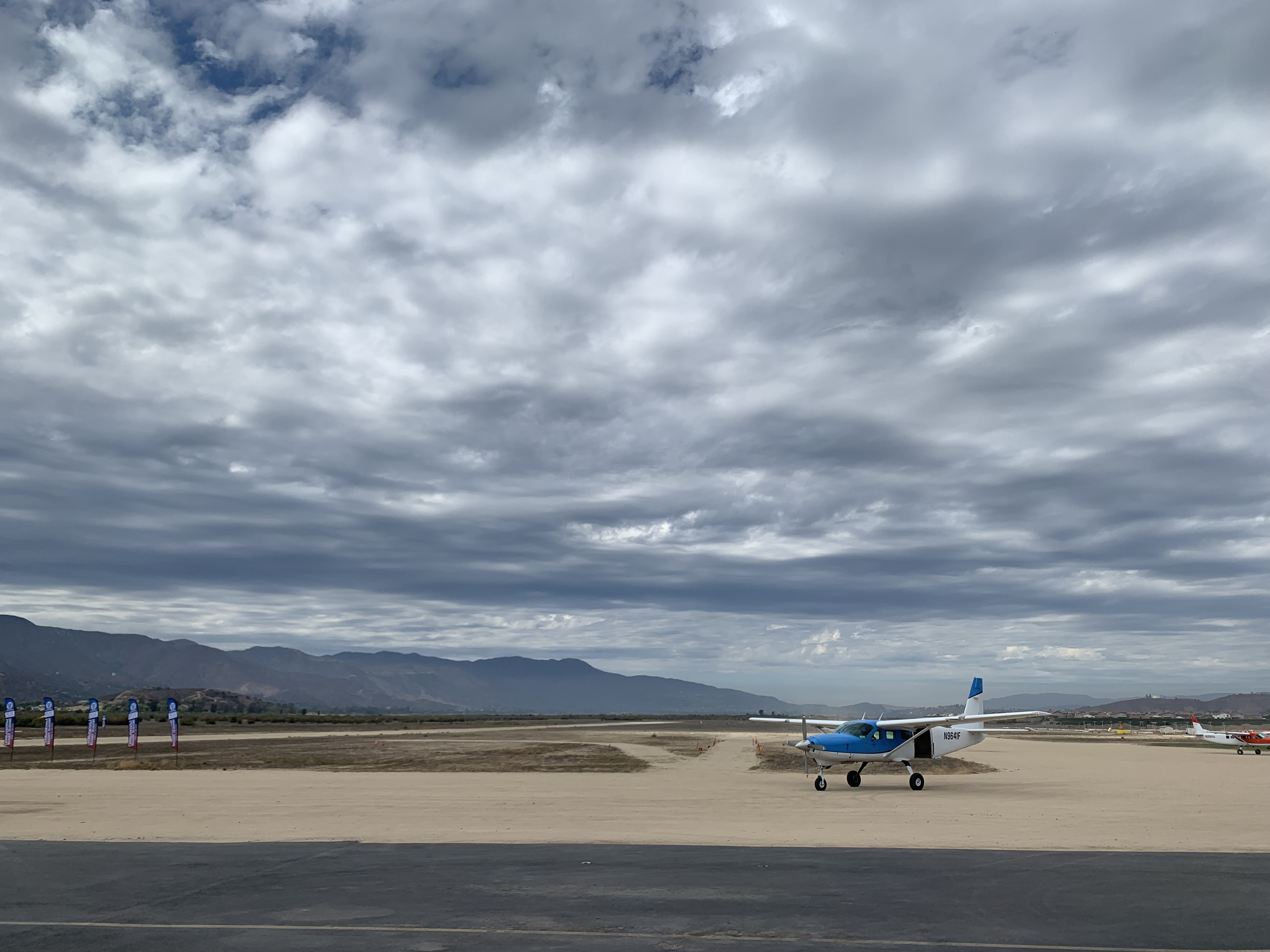
This year’s competitors jumped from Caravans and contended with challenging skies, dodging low clouds and shifting conditions. The first day of competition was weathered out entirely due to overcast layers.
In Round 1, Nik faced a suit malfunction when his zipper came undone mid-dive—causing his suit to inflate and slow him during the scoring window. Still, he recovered across subsequent rounds to secure the overall victory.
The event featured 16 competitors, including two guest flyers from Great Britain and four female competitors, underscoring the sport’s growing international and gender-inclusive reach.
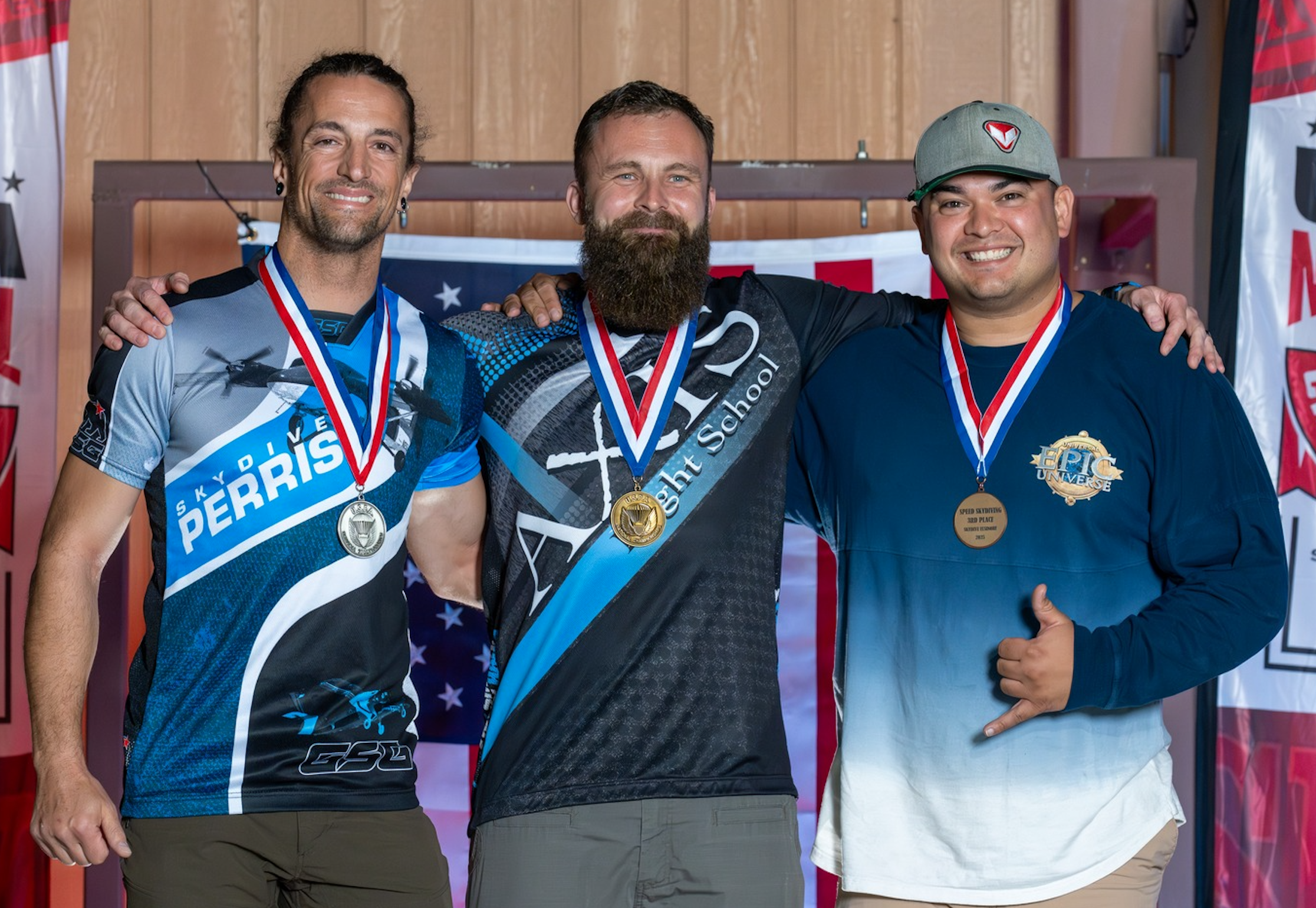
Scores by InTimeScoring.comFrom left to right: 2nd Matthew Fry, 1st Niklas Daniel, 3rd Michael Goodwin. Photo by USPA.
Both Matt Fry and Michael Goodwin achieved personal bests that earned them a place in the coveted “500 Club”—a distinction reserved for skydivers who exceed 500 km/h in competition. They become members #20 and #21 of this elite group.
Matt’s performance placed him #8 overall and Michael #18 in the ISSA Eternal Rankings. Matt also became the sixth competitor in history to maintain speeds above 500 km/h across all eight competition rounds—a feat of precision and endurance.
As the newly formed USA Speed Skydiving Team, Nik, Matt, and Mike currently hold an aggregate team average of 511.85 km/h. For perspective, the current world record, set by Team Australia at the 2025 FAI World Cup in Austria, stands at 500.91 km/h.
With a year to prepare for the 2026 FAI World Championships, the U.S. team is poised to push those limits even further.
USPA Records and National Achievements
AXIS coaches Nik Daniel and Brianne Thompson also set multiple national and state records during the event. Some performances would have qualified for North American continental records, but could not be ratified due to insufficient judge ranking—an administrative limitation that underscores the growing need for higher-rated officials in U.S. speed events.
Meet the 2025 U.S. Speed Skydiving Team
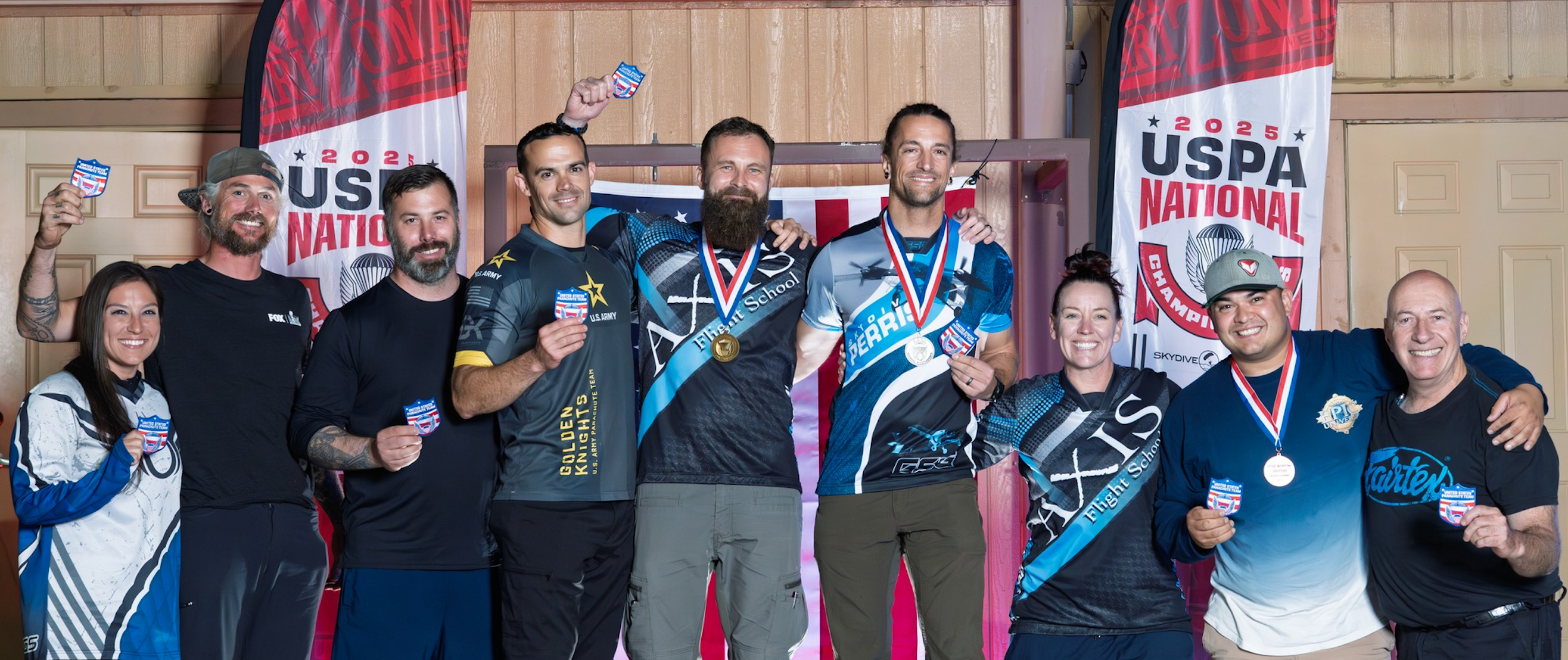
Representing the United States in 2026: Jessica Twarog, Patrick Kessler, Jordan DuJack, Daniel Osorio, Niklas Daniel, Matthew Fry, Brianne Thompson, Michael Goodwin, and Eugenio Ciurana.
Nik and Brianne are now preparing to represent the U.S. on home turf at the 2026 World Championships, hosted at Skydive Arizona—a fitting stage for two of the sport’s most experienced athletes and coaches.
Left to right: Jessica Twarog, Patrick Kessler, Jordan DuJack, Daniel Osorio, Niklas Daniel, Matthew Fry, Brianne Thompson, Michael Goodwin, Eugenio Ciurana with their USA Team patches. Photo by USPA.
New Mixed-Team Event Comes to the U.S.
In a forward-looking move, the USPA Board of Directors has voted to adopt the Mixed Speed Event, a 3-round team category pairing one male and one female competitor. The event mirrors the FAI’s international format, in which mixed-gender teams fly an additional 3 rounds beyond the Open category.
The U.S. will officially add the Mixed Speed Event in 2027, but—as expected—the speed community didn’t wait that long to test it.
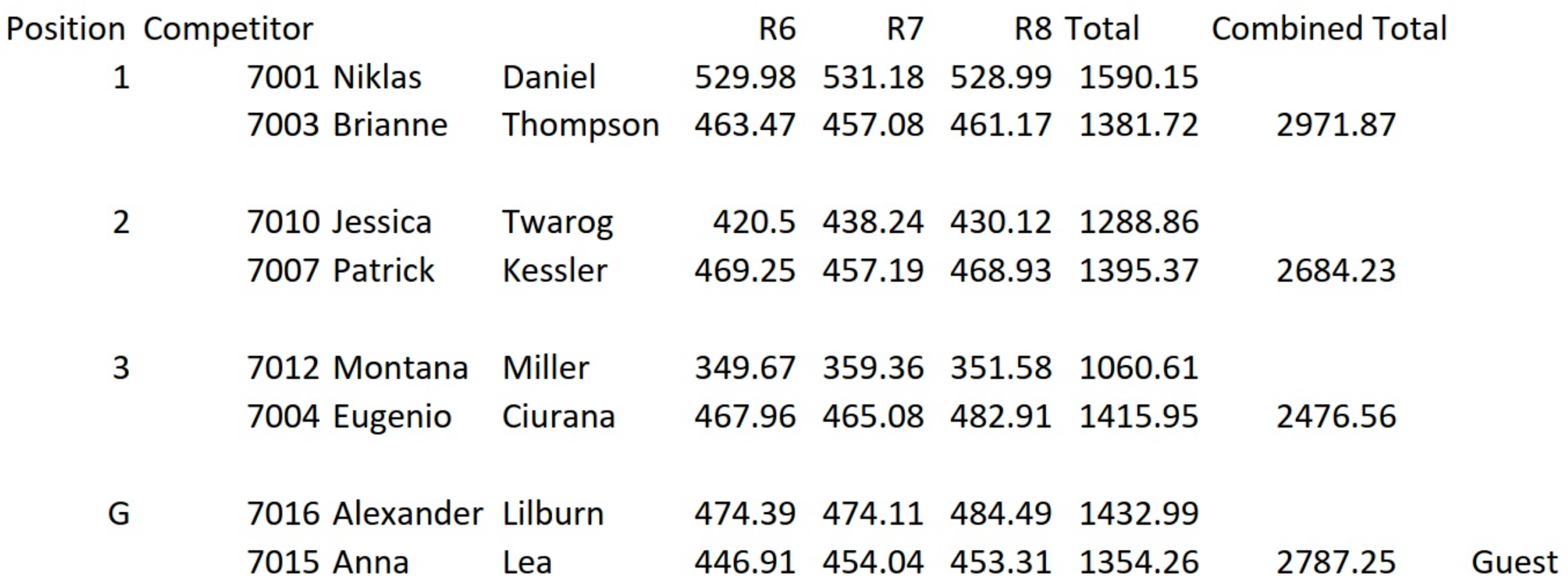
The first unofficial U.S. mixed-team results were aggregated from the 2025 Nationals, with Team AXIS (Nik Daniel & Brianne Thompson) taking the top spot at a combined total of 2971.87 km/h.
Thanks and Acknowledgements
AXIS Flight School extends congratulations to every competitor and thanks to Skydive Elsinore for hosting a smooth, safe, and spirited event.
A special thank-you to our sponsors—whose continued support keeps us flying fast, pushing boundaries, and sharing knowledge across the skydiving world.
About AXIS Flight School
AXIS Flight School, based at Skydive Arizona, offers world-class coaching across disciplines—from foundational freefall skills to elite competition training. AXIS is led by professional instructors Niklas Daniel and Brianne Thompson who are both members of the U.S. Parachute Team.
This article, created in collaboration with ParaMag publisher Bruno Passe, marks a milestone. For the first time, Speed has been introduced in depth to French readers—bringing a fresh perspective on the world’s fastest non-motorized sport to a country that has shaped skydiving history in so many other disciplines.
Why This Matters
France has produced world-class skydivers across Formation Skydiving, Freefly, Canopy Piloting, Wingsuiting—you name it. But when it comes to Speed Skydiving, the French flag is conspicuously absent from the scoreboard.
That’s surprising, because Speed isn’t just thrilling to watch. It’s a discipline that:
Has one of the lowest barriers to entry (no specialised rig needed – just freefly friendly).
Sharpens bodyflight awareness that transfers to every other discipline.
Lets you measure progress instantly with clear, objective data.
It’s an adrenaline-fueled challenge and a technical journey rolled into one.
“I have competed agaist the French in a variety of discipines at the world level,” says Nik, “and they have always had athletes of the highest caliber. I know that, if they were to join the race in speed, they would do amazingly well.”
A First Step Into Speed
Back in January, Nik wrote “Speed Skydiving Wants You”—which lays out exactly what you need to get started. If the ParaMag feature sparks your curiosity, that’s the perfect next read.
AXIS Flight School also offers resources and coaching to help athletes from across the globe to build a foundation safely and effectively.
Where to Jump In
The Speed community is small, but growing—and ouais, there’s room for you. The ISSA World Cup Series would be a great option for a first comp. The 2026 Calendar has not been published yet, but watch https://www.issa.one/event-directory/ for updates.
Whether you’re flying the tricolore or any other flag, the Speed community is excited to welcome fresh faces.
Nous Vous Invitons
France has always been on the leading edge of skydiving innovation and achievement. And now it’s time to bring that tradition of excellence to Speed.
So—if you’re a French skydiver who thrives on challenge, precision, and raw velocity: we want to see you in the dive pool.





 The Drop