
The 6th FAI World Speed Skydiving Championships at Skydive Arizona delivered record-breaking performances, a remarkable battle for gold, and a reminder that the future of the sport is being shaped both in freefall and on the ground.
ELOY, ARIZONA — At the 6th FAI World Speed Skydiving Championships, the difference between winning gold and taking silver came down to just 1.43 km/h (0.8mph). Across eight rounds of competition, Sebastian García Gutiérrez and Niklas Daniel pushed one another to extraordinary speeds, turning the open category into a battle that remained alive until the final round.
Sebastian ultimately claimed the world title with an overall average of 540.59 km/h (335.89 mph), while Niklas finished second at 539.16 km/h (335.00 mph). Simon Walsh of Australia completed the podium with a 533.72 km/h (331.38 mph) average.
The numbers alone tell an extraordinary story. Both Sebastian and Niklas averaged speeds approaching last year’s world-record single-round performance over the course of an entire eight-round competition — yet their separation was less than 1.5 km/h in average. In a discipline where a single run can change the standings, their consistency and ability to deliver under pressure were exceptional.
Perhaps even more remarkable is what those results say about the sport as a whole.
An overall average of 530 km/h, an achievement that would have been extraordinary not long ago, is no longer enough to guarantee a place on the podium. The standard has shifted. And the world’s fastest skydivers are moving that standard together.
TWELVE years on the world stage
Speed skydiving has existed since the early 2000s, but 2026 marks twelve years since the discipline first appeared at the FAI World Championship level. From the inaugural championship in Prostejov Czech Republic , in 2014 to this year’s return to Eloy, the sport has grown on all axes: participation, performance, and international reach.
The figures show a discipline that has steadily built an international community. Although this year’s field was smaller than the previous World Cup, it was still more than twice the size of the inaugural championship.
| Year | FAI World Championship or World Cup | Location | Competitors |
|---|---|---|---|
| 2014 | World Cup | Prostějov, Czechia | 16 |
| 2016 | World Championship | Chicago, Illinois, USA | 23 |
| 2017 | World Cup | Saarlouis, Germany | 21 |
| 2018 | World Championship | Gold Coast, Australia | 31 |
| 2019 | World Cup | Dunkeswell, United Kingdom | 28 |
| 2020 | World Championship | Cancelled due to COVID-19 | — |
| 2021 | World Championship | Tanay, Russia | 27 |
| 2022 | World Championship | Eloy, Arizona, USA | 32 |
| 2023 | World Cup | Prostějov, Czechia | 31 |
| 2024 | World Championship | Beaufort, North Carolina, USA | 44 |
| 2025 | World Cup | Hohenems, Austria | 61 |
| 2026 | World Championship | Eloy, Arizona, USA | 47 |
* Historical sidenote – In 2012 Speed Skydiving was a test event during the Dubai Mondial.
This year’s field represented Spain, the United States, Australia, the Netherlands, Germany, Switzerland, Poland, Sweden, Great Britain, Austria, Italy, and New Zealand. Speed skydiving also drew more competitors than canopy piloting or eight-way formation skydiving at the championships.
The competition schedule reflected the discipline’s efficiency as well as its intensity. All eight rounds of the open event were completed in just two days, a remarkable achievement at a major international championship.
There was, however, one notable absence.
Anna, from Germany, suffered a broken leg during training in Eloy just days before the event, bringing the potential field to 48. The speed community wishes her a full and speedy recovery, along with safe travels home.
The open race: a contest worthy of a world title
The open category provided the championship’s defining contest. Sebastian and Niklas traded world-class performances throughout the eight rounds, with neither athlete able to establish a decisive advantage.
Sebastian’s winning average of 540.59 km/h was built on a series of remarkably fast runs, including a 545.09 km/h round. Niklas answered with a consistently high level of performance, finishing just 1.43 km/h behind over the full competition.
Simon Walsh secured third with a 533.72 km/h average, completing a podium in which all three athletes averaged more than 530 km/h.
- Gold: Sebastian Garcia Gutierrez — 540.59 km/h
- Silver: Niklas Daniel — 539.16 km/h
- Bronze: Simon Walsh — 533.72 km/h
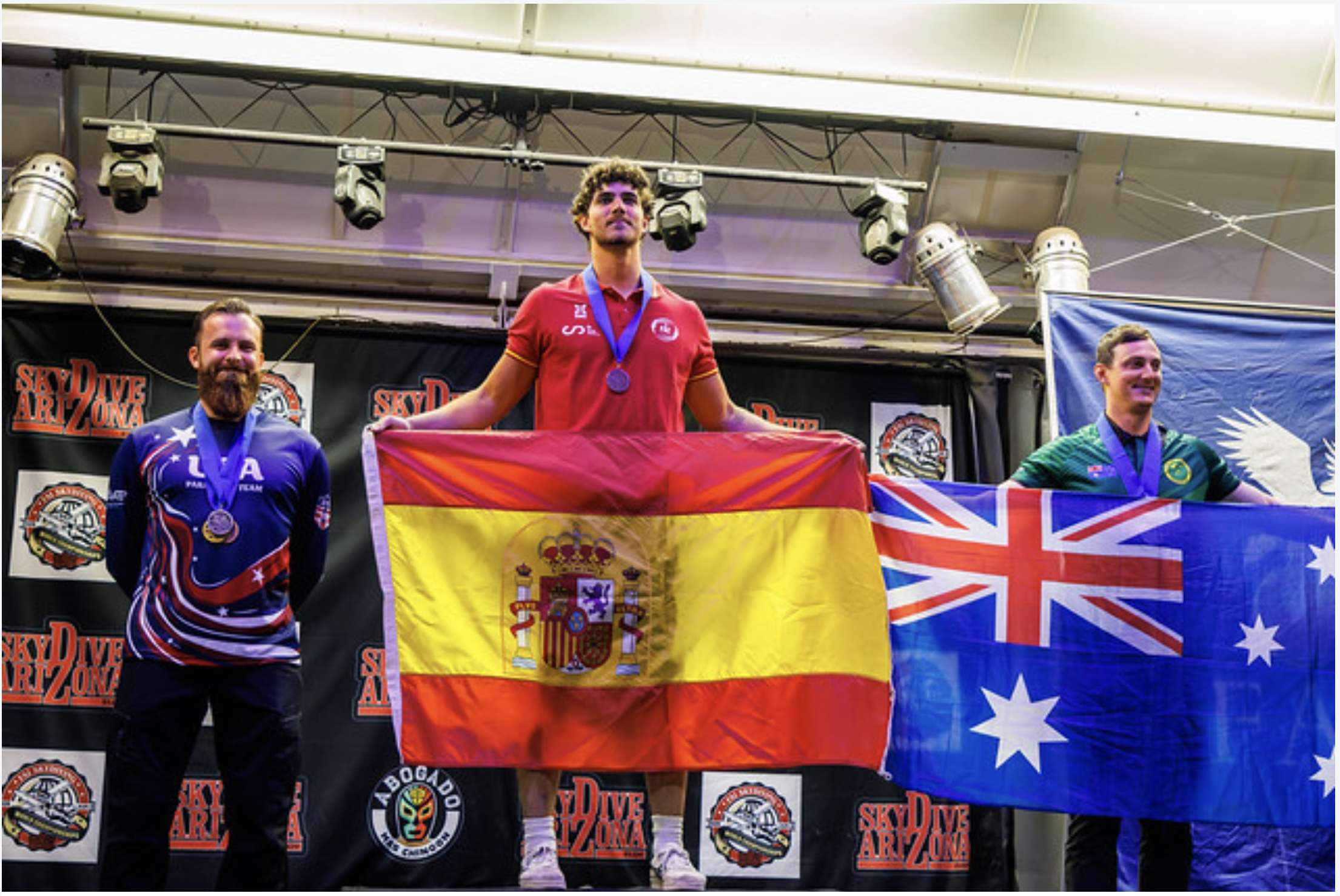

For Niklas, the result was the end of a hard-fought championship and the beginning of a moment of sportsmanship that captured the spirit of the event. As the Tim Mace Trophy passed to Sebastian, Niklas offered his rival a straightforward message:


“That was a hell of a battle. I gave it everything I had. Sebastian, you earned this. Congratulations!”
The exchange was a fitting conclusion to a contest defined by mutual respect. At these speeds, the competitors are not simply racing the clock; they are challenging one another to reach performances that few thought possible only a few years ago.
Women’s speed reaches a new milestone

Natisha Dingle delivered one of the championship’s landmark performances, winning the female category with an overall average of 500.59 km/h. In doing so, she became the first woman to break the 500 km/h barrier in competition and joined the increasingly exclusive club of athletes who have reached that milestone.

Natisha’s achievement also marked a significant moment in the progression of women’s speed skydiving. Her rounds included 507.94 km/h and 508.50 km/h, with the latter helping establish a new benchmark for female competition performance. She also surpassed the previous female world-record performance held by Brianne Thompson, which had stood for two years.
Tanita Rutherford made her own statement in round eight, recording 501.00 km/h to become another woman to cross the 500 km/h threshold. She finished second overall in the female category with an average of 495.93 km/h, while Ingrid van Deelen claimed third at 473.36 km/h.
The female podium was:
- Gold: Natisha Dingle — 500.59 km/h
- Silver: Tanita Rutherford — 495.93 km/h
- Bronze: Ingrid van Deelen — 473.36 km/h


Not long ago, the 500 club was an exceptionally small group. Now, more athletes are joining it, and the milestone is becoming an increasingly realistic target rather than a distant ambition. That is a healthy sign for the discipline: athletes are learning from one another, equipment is evolving, and the performance ceiling continues to rise.
The male and female junior categories remain part of the sport’s competitive structure, but neither was contested at this championship because there were insufficient competitors in the relevant age ranges.
A new category and a wider competitive field
The 2026 championship also introduced the master category (50+), recognising athletes competing in an additional age-based division. Thorsten Morhaus took the inaugural title with a 499.39 km/h average, followed by Robert Pelka at 497.17 km/h and Daniel Hagström at 479.80 km/h.
The master podium was:
- Gold: Thorsten Morhaus — 499.39 km/h
- Silver: Robert Pelka — 497.17 km/h
- Bronze: Daniel Hagström — 479.80 km/h

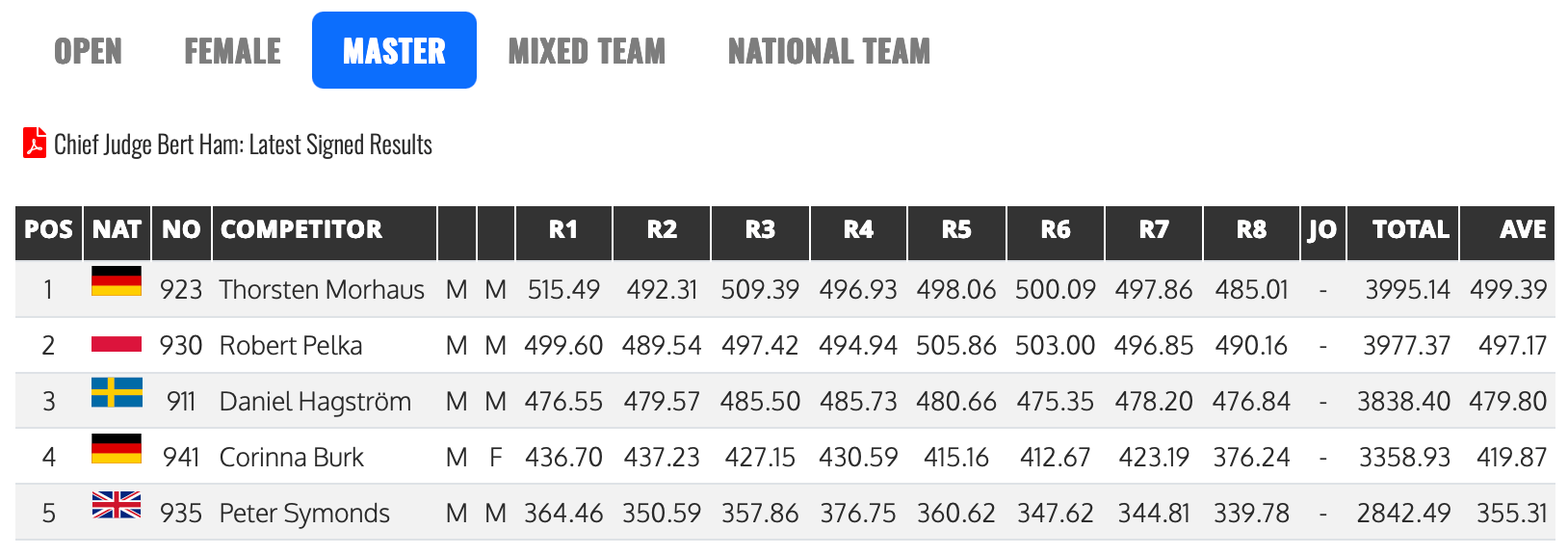
The introduction of the category represents another step in broadening the competitive opportunities available to speed skydivers. As the discipline matures, categories that recognise different stages of an athlete’s career can help keep experienced competitors engaged while encouraging participation across a wider range of ages.
National Team: the United States takes gold
The National Team event added another dimension to the competition, rewarding the combined performance of a country’s competitors across the eight rounds. Rather than relying on one standout athlete, the team standings reflect the depth and consistency of a national programme.
The United States (Michael Goodwin, Matthew Fry, and Niklas Daniel) claimed gold with an overall team average of 522.59 km/h, followed by Australia at 513.03 km/h and Germany at 506.15 km/h.
The podium was:
- Gold: United States — 522.59 km/h
- Silver: Australia — 513.03 km/h
- Bronze: Germany — 506.15 km/h


The American team’s performance demonstrated the value of a deep field, while Australia’s silver and Germany’s bronze highlighted the strength of the international competition. The team event also provided an opportunity to recognise national records alongside the individual achievements recorded throughout the championship.
Mixed Team: teamwork, opportunity, and a lesson in sportsmanship
The mixed-team event pairs male and female speed skydivers, offering a team competition that encourages athletes to compete together across genders. Its purpose extends beyond the medals: it provides a practical way to bring more women into the discipline, build partnerships, and create a stronger competitive community.
Every female competitor in the open field entered the mixed-team event, achieving a 100% participation rate among the women. That is precisely the kind of engagement the event is intended to encourage—creating more opportunities for women to compete alongside their peers, gain experience, and remain active in the discipline.
Australia dominated the podium, taking first and second place, while the United States finished third.
The results were:
- Gold: Australia MT 1 — 519.44 km/h
- Silver: Australia MT 2 — 499.59 km/h
- Bronze: USA MT 1 — 494.57 km/h


Australia MT 1 delivered a particularly strong series, improving from 512.02 km/h in round one to 526.90 km/h in round three. The team’s 519.44 km/h average underlined the potential of the format and established an important performance benchmark for mixed-team competition.
The event was scheduled for three rounds and would normally take only an afternoon to complete. This time, however, the Arizona weather had other plans. After the first round, conditions deteriorated. Competitors had to land with the aircraft twice while attempting to complete round two, and the following day was lost entirely to weather, with clouds giving way to strong winds. The event’s abbreviated schedule made every completed round count.
The chinstrap incident
One incident during the first round captured the spirit of the community particularly well.
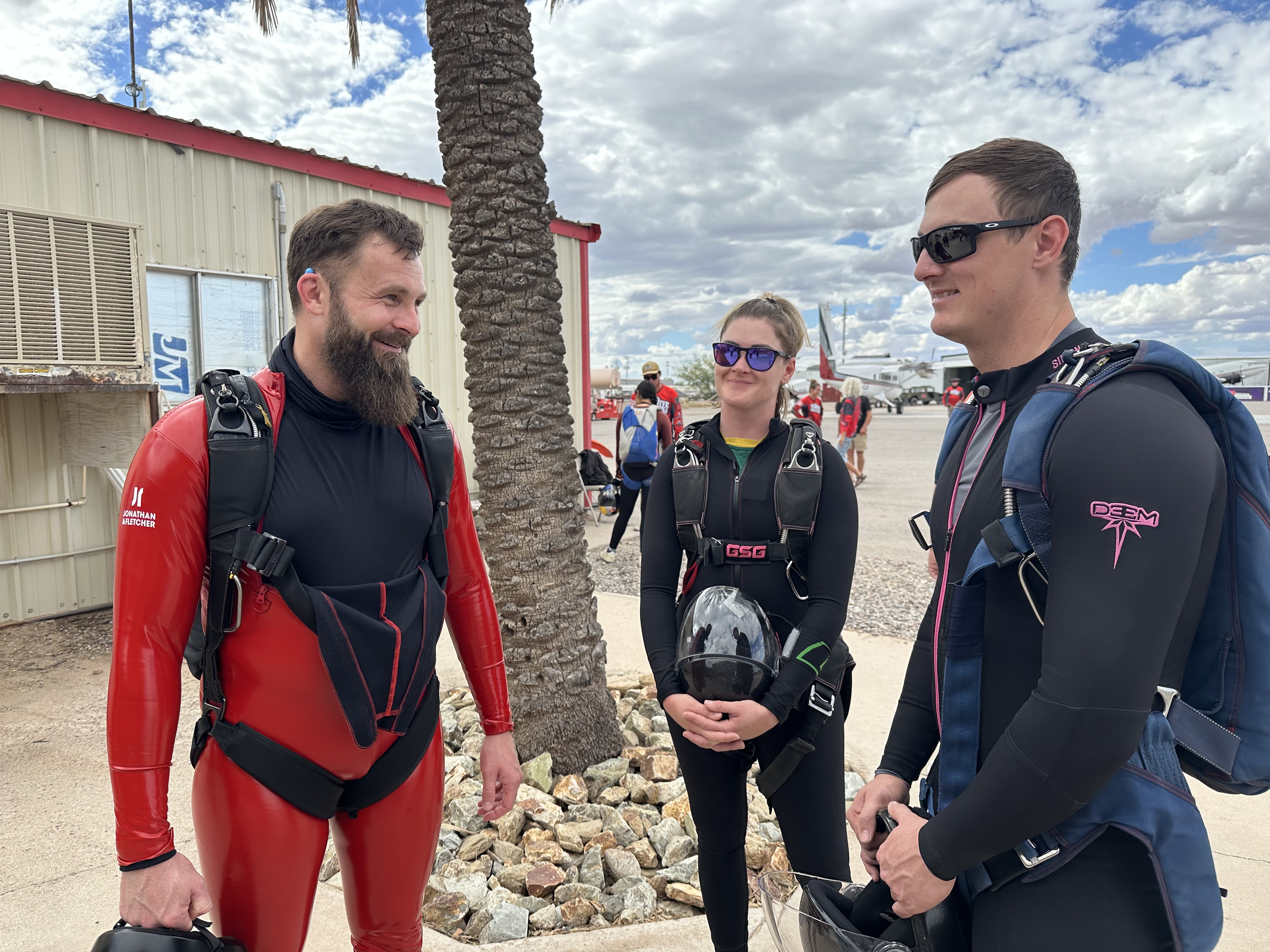
As Niklas was putting on his helmet, its buckle broke. A loose (or unstable) helmet can compromise both aerodynamic performance and safety. He needed a reliable repair before making his run.
Simon Walsh of Australia immediately offered duct tape from his own helmet that was securing his visor, allowing Niklas to secure the chinstap and make a successful jump. There was no hesitation, and no negotiation. Just one competitor helping another get safely to the start line.
It was a small gesture, but a meaningful one. On the scoreboard, Simon and Niklas were rivals. In the aircraft and on the ground, they were members of the same community.
Records, consistency, and the pursuit of speed
The championship produced a significant collection of new competition and performance records under the FAI’s G-1 and G-2 classifications (59 of them to be exact – see below). G-1 records relate to competition results, while G-2 records recognise performance achievements. Together, they provide a way to track not only who wins a championship, but also how the limits of the discipline continue to change.
Sebastian’s extraordinary open-category performance and Natisha’s historic female results were among the defining achievements. The team events added further milestones, with national and mixed-team performances demonstrating that record progression is not confined to individual competition.
The record-setting performances also need to be understood in the context of the sport’s development. As athletes become faster, the margins separating the leading competitors become smaller, and each round carries greater significance. A new record is no longer simply a matter of one athlete outperforming the field; it may require an entire competition to be executed at an exceptional level.

Consistency is a crucial part of that equation.
Anna Lea of Great Britain was a standout example, recording the lowest standard deviation (SD) in the competition. Standard deviation measures how much an athlete’s round speeds vary from their average, so a lower figure indicates more consistent performance. At the elite level, where fractions of a kilometre per hour can decide a medal, the ability to reproduce a high speed repeatedly is an important competitive advantage.
Her performance is a reminder that speed skydiving rewards more than a single spectacular run. It rewards the ability to prepare, execute, and repeat under pressure.
Top 5 athletes by lowest standard deviation
Ranked from lowest to highest standard deviation across all 8 rounds:
| Rank | Athlete | Standard deviation |
| 1 | Anna Lea (UK) | 2.05 |
| 2 | Niklas Daniel (USA) | 2.25 |
| 3 | Tanita Rutherford (AUS) | 2.57 |
| 4 | Sebastian Garcia Gutierrez (ESP) | 3.45 |
| 5 | Heath Baird (AUS) | 3.49 |
Getting faster starts on the ground
The speeds recorded in Eloy are not the result of technique alone. Over the past two years, many dedicated speed skydivers have made visible changes to their physical preparation, placing greater emphasis on strength training, nutrition, and recovery.
The modern speed skydiver is increasingly an athlete in the full sense of the word. Time spent at the drop zone remains essential, but competitors are also investing more time away from it, building muscle, improving physical conditioning, and refining the routines that allow them to train and recover effectively.
As AXIS Flight School’s Niklas Daniel puts it:
“The work that makes an athlete faster can happen in the gym, in the kitchen and during recovery just as much as it happens at the drop zone.”
Equipment development is another part of the picture. Competitors are experimenting with newer designs and configurations, including dimpled helmets and neck collars, in an effort to change their aerodynamic signature and reduce drag. At speeds above 500 km/h, even small changes can be worth investigating.
These approaches are not isolated trends. They reflect a broader shift in how the discipline approaches performance: combining freefall technique, physical preparation, equipment development, and careful analysis of results.
The athletes who will shape the next decade of speed skydiving are likely to be those who understand how these elements work together.
A community that keeps pushing forward
For all the focus on speeds, averages, and records, the championship was also a celebration of the people who make the discipline possible.
Forty-seven competitors from 12 countries came together in Eloy to pursue a shared challenge. They raced hard, supported one another, exchanged knowledge, and celebrated performances that raised the standard for everyone. The help Simon offered Niklas, the respect shown during the Tim Mace Trophy handover, and the participation in the mixed event all reflected the same underlying principle: competitors can be fierce rivals without losing sight of the community they belong to.
The FAI’s extensive coverage of the championships, including regular updates through Facebook and Instagram and photographs on Flickr, also helped share the achievements with a wider audience. The competition-site video offers another view of the atmosphere in Eloy and the people behind the performances.
Ten years after speed skydiving entered the FAI world championship programme, the discipline is faster, more competitive, and increasingly international. Participation has grown substantially, women are breaking barriers that once seemed out of reach, and team formats are creating new opportunities for athletes to compete together.
The next generation of speed records will demand more from athletes than ever before. But if Eloy demonstrated anything, it is that the sport’s progress is not driven by speed alone. It is driven by preparation, curiosity, competition, and a community willing to help one another go faster.
The numbers will keep climbing. The margins will keep shrinking. And the next chapter of speed skydiving is already taking shape.
All 59 G1 and G2 Records


One More Day of Speed?
Although the competition portion of the Speed Skydiving World Championships concluded on the 23rd, there was still one more day of flying before the championships officially came to a close.
On the 24th, AXIS Flight School organized a high-altitude exhibition load that would have given speeders an opportunity to push their limits beyond the usual parameters of competition. Unfortunatly clouds rolled in and cancelled the event. We appreciate Skydive Arizona and the FAI judges for proving their time and efforts for the preperations they put in. The additional jump could have allowed the athletes to break more G-2 records, maybe net time.
Taking it Indoors

With the official competition behind them, the final day also offered a chance to celebrate the achievements and friendships forged throughout the championships.
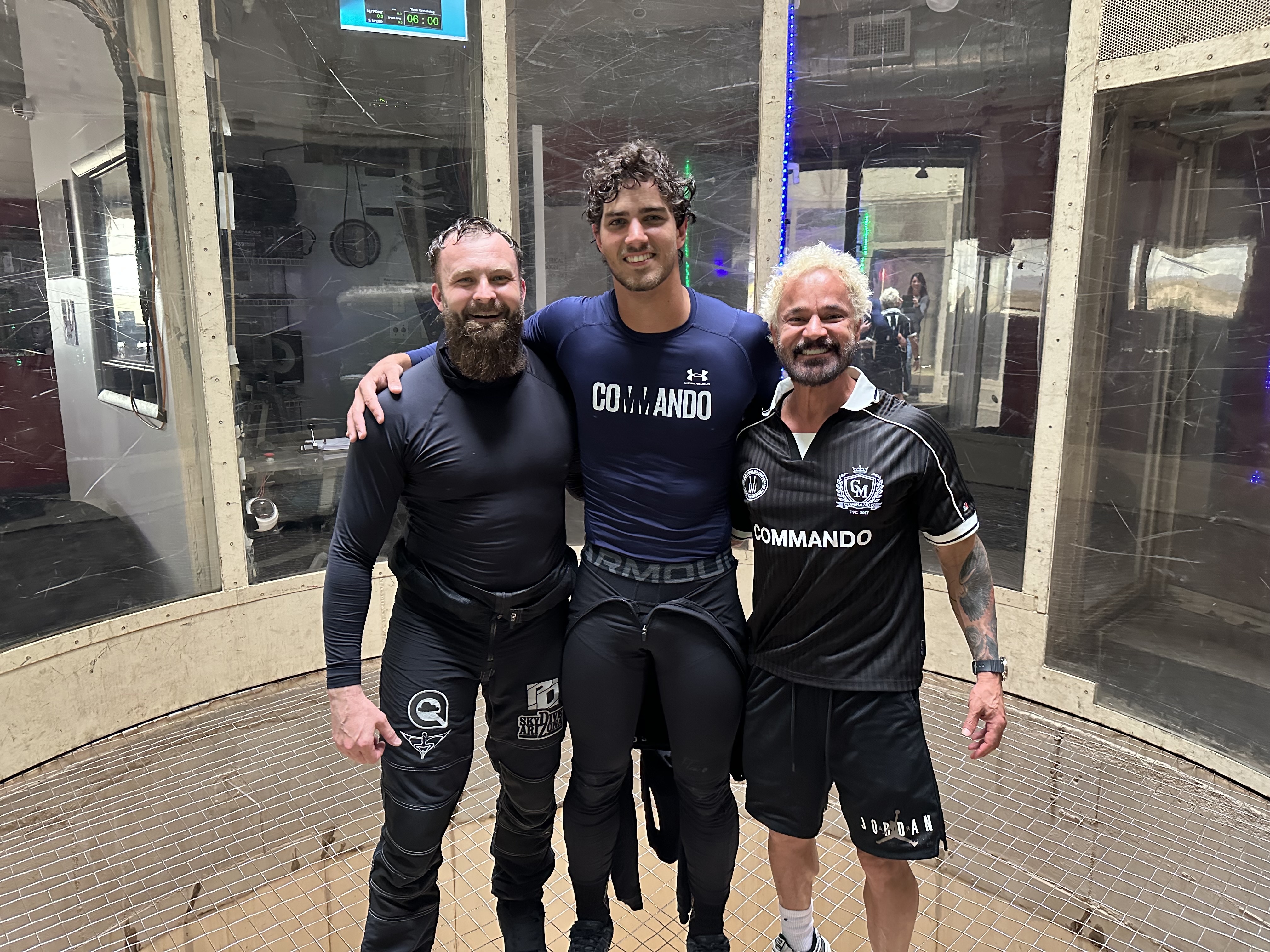
To mark Sebastian Garcia’s accomplishments, Nik booked 20 minutes of tunnel time at SkyVenture Arizona and had Sebastian join him for a session purely for fun. The two could be seen flying around the tunnel walls, carving turns and chasing lines with huge smiles on their faces. A fitting end to a week defined by speed, skill, and a shared passion for flight.
Thank You Sponsors and Supporters!
A huge thank you to our incredible sponsors, Althoff & Voeller, Cookie Composites, Flysight, L&B Altimeters, Performance Designs, Skydive Arizona, United Parachute Technologies, Cypres, and Vertical Suits, for supporting us at the 2026 FAI World Speed Skydiving Championships! Your generosity, trust, and support made all the difference, giving us the opportunity to chase our dreams, push our limits, and proudly represent our country on the world stage. We couldn’t have done it without you, and we’re truly grateful to have you as part of our team.
Thank you for being part of this journey!


Leave a Reply