

The 2026 USPA Speed Skydiving National Championships descended on Skydive Perris in Southern California over Labor Day weekend, September 5–7. For AXIS, it was much more than another national championship. It was a final proving ground before the FAI World Championships—and, as it turned out, one of the most demanding Speed Skydiving competitions any of us have experienced.
With weather delays, rain, heat, altitude changes, an exhausting 13-hour competition day, and speeds pushing well beyond 500 km/h, the weekend had just about everything a Speed Skydiver could ask for.
And then Niklas Daniel went 542.65 km/h.

Arrival
We arrived at Skydive Perris Saturday morning to a drop zone already buzzing with competition activity. Canopy Formation and Wingsuit Acro were in full swing, while teams preparing for their events were rehearsing on the ground.
The sky was clear, and every so often the unmistakable sound of a Speed Skydiver ripping through the air could be heard from the ground.
After registration, AXIS got in some valuable practice jumps from the Super Twin Otter before taking a little time to rest and prepare for the evening competitors’ briefing.
It was the calm before the storm.
The Competitors’ Briefing
The evening briefing was quick and efficient—a well-oiled machine with Competition Director Scott Smith and Chief Judge Steve Hubbard at the helm.
The competitors were brought up to speed on the rules, weigh-ins, equipment inspections, helmet custody procedures, and everything else required to get the competition underway.
The field was made up mostly of familiar faces, including many members of the current United States Parachute Team who will represent the U.S. at the upcoming FAI World Championships at Skydive Arizona in Eloy.
That made these Nationals particularly important. For many of us, this wasn’t just a national championship. It was the final major training opportunity before the World Championships.
In total, 12 competitors took the start, including two women and one Master competitor. There were no international guest competitors.
The biggest question hanging over the competition wasn’t the field, however. It was the weather.
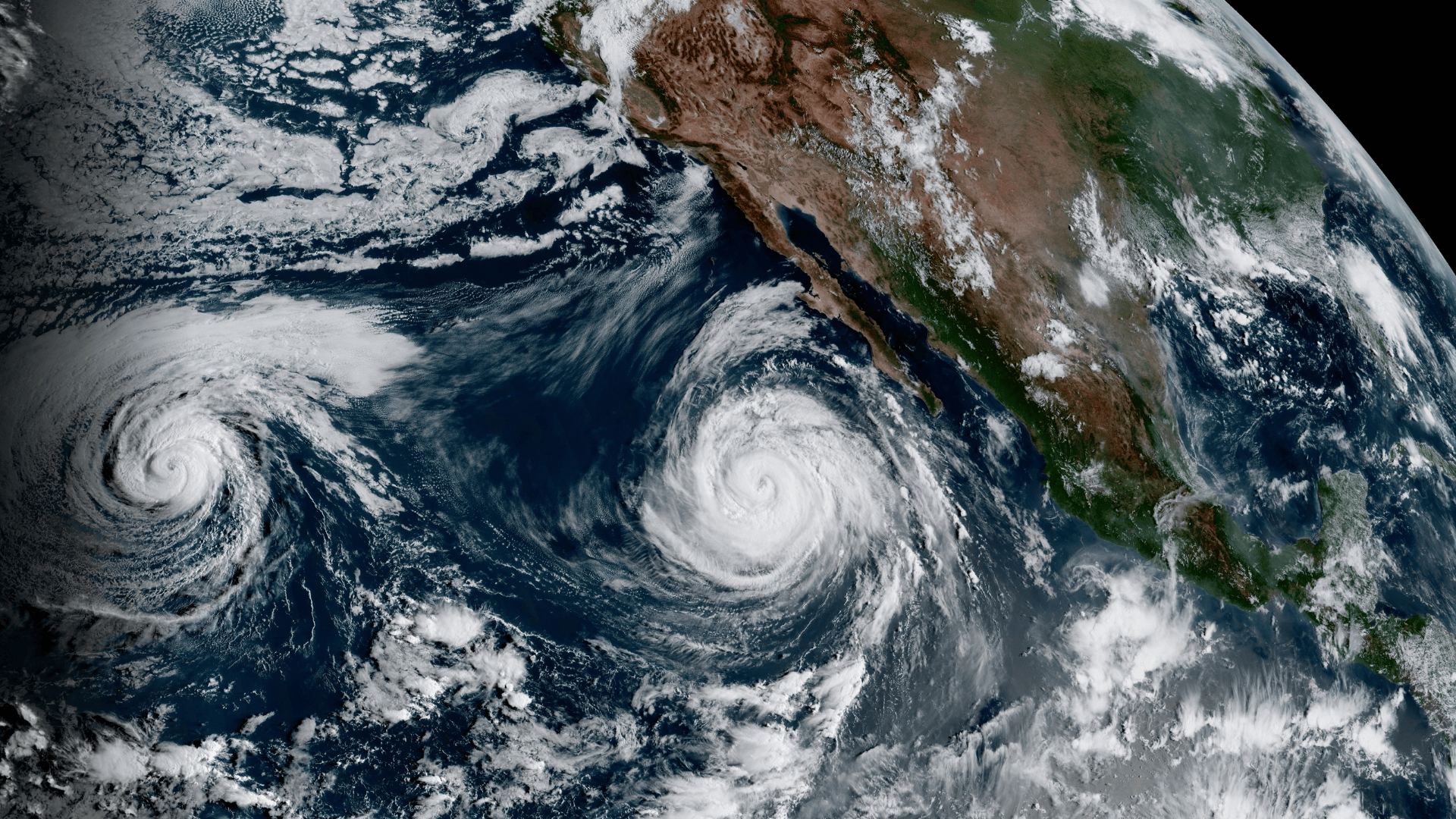
Hurricane Marie was sitting off the coast of Baja California, with forecasts calling for significant rain in Southern California. For a competition where every jump depends on a usable column of air from the aircraft to the performance window, that was not exactly encouraging.
Mixed Team Speed Skydiving Becomes Official
There was another important development at this year’s Nationals.
For the first time, USPA formally recognized the Speed Skydiving Mixed Team category.
The format pairs one female and one male competitor, with their performances combined to determine the team result. The concept has already been incorporated into FAI Speed Skydiving competition, and the 2026 FAI rules specify a two-person mixed team made up of competitors of different genders representing the same National Airsport Control (NAC) organization.
USPA had previously run the format as a test event at Skydive Elsinore in 2025. Niklas Daniel and Brianne Thompson won that event, but because the category was not yet officially recognized, there were no official medals or records. That changed in 2026.
Two mixed teams entered the Nationals:
– Niklas Daniel & Brianne Thompson
– Matthew Fry & Jessica Twarog
For AXIS, this added another layer of competition to an already busy weekend.
Competition Day 1: Grounded
Sunday morning began with an expected weather hold.
And then the weather won. The entire day was eventually washed out.
There wasn’t much left to do except watch the clouds roll through, enjoy the rain that we so rarely see in the Southwest, and wait for another chance.
For Speed Skydivers, though, a weather day isn’t necessarily wasted. It gives the athletes time to reset, inspect equipment, visualize the jumps, and prepare mentally for what can become a very long competition day.
We just didn’t know quite how long that day was going to be.
Competition Day 2: The Race Is On
Competitors went on call at 0600 with an overcast sky overhead and occasional drizzle.
The pilots reported that the cloud ceiling was fluctuating between approximately 8,000 and 13,000 feet AGL. For Speed Skydiving, that difference matters.
Altitude is not simply a number on the altimeter. It directly affects the amount of usable performance window available to the athlete.
The race track starts after exit and extends through the measurement window. The more altitude available, the more opportunity the athlete has to accelerate and establish a high terminal speed before the scoring window closes.
With the ceiling moving around, we knew some jumps could be compromised before we even got on the plane.
Fortunately, by the time we reached altitude for Round 1, the sky cooperated.
The aircraft climbed to 13,484 feet (4,110 m), giving the competitors a solid performance window.
The scoreboard started filling up.
And then Nik came out swinging.
540 km/h
Niklas Daniel put together a spectacular first round, posting 540.03 km/h and becoming the first competitor to break the 540 km/h barrier in competition.
But there was an unusual complication.
Because USPA was unable to field a judging panel holding the current FAI credentials required for international record recognition, the performances from this competition could not be submitted as FAI-recognized world records.
That technical distinction is important in Speed Skydiving. A performance can be faster than an existing international record while still not becoming an official FAI record if the competition does not meet all of the requirements for record recognition.
For Nik, however, there was an even better way to answer the question of whether Round 1 was a fluke.
He did it again.
And again.
Nik exceeded his opening score in Rounds 2, 4, 5, and 6, ultimately reaching a competition personal best of 542.65 km/h (337.19 mph).

That is an extraordinary number.
The Weather Fights Back
By Round 3, the clouds were beginning to descend again.

Photo by Niklas Daniel.
Competitors encountered rain and reduced visibility around exit, adding another layer of difficulty to an already demanding event. At more than 500 km/h, there isn’t much margin for distraction. The job is to exit cleanly, establish the correct body position, accelerate as efficiently as possible, and hold that performance through the scoring window.
Then get back on the plane and do it again.
Eventually, the weather gave us enough openings to keep moving.
And moving we did.
Eight Rounds. One Day. Thirteen Hours.
Despite the weather, all eight competition rounds were completed in a single day.
That sounds straightforward until you look at the clock.
From the beginning of Round 1 to the completion of Round 8, the jumping portion of the competition lasted approximately 13 hours.
According to Randy Connell, this was the first time in U.S. history that a Speed Skydiving competition had completed all eight rounds in a single day.
Normally, a competition of this intensity is spread over multiple days, giving competitors time to recover between rounds. This time, however, the first competition day had been completely lost to weather, and the meet officials were determined to get all eight rounds completed.
To make that possible, ground time between calls was reduced from the usual hour to roughly 45 minutes.
That doesn’t sound like a huge difference until you’re actually doing it.
A Speed Skydiving competition jump is physically demanding. Add the climb to altitude, the jump itself, landing, walking back, debriefing, equipment checks, packing your own parachute, and preparing mentally for the next round—and 45 minutes disappears quickly.
Then the weather would stop us again.
The result was a cycle of hurry, wait, jump, recover, pack, and repeat.
And the heat didn’t help.
Temperatures at Perris reached approximately 94–99°F (34–37°C) during the day, while temperatures at altitude dropped to roughly 45–52°F (7–11°C). The air was also humid.
By the final rounds, stamina and resilience were every bit as important as technique.
The final round was particularly painful.
We were forced to jump from only 11,676 feet (3,559 m). With less altitude available, competitors simply didn’t have the same amount of vertical space to complete the acceleration phase before entering the scoring window.
The result was immediately visible on the scoreboard: everyone’s overall average took a hit.

The Results
Gold — Niklas Daniel

The “King of the Speed Demons” delivered an historic performance.
Nik remained untouchable throughout the competition and repeatedly pushed the limits of what was possible under the conditions. His 542.65 km/h (337.19 mph) competition personal best moved him back into the top position in the ISSA Global Eternal Rankings.
More importantly, it demonstrated that Nik’s form is exactly where he wants it to be heading into the FAI World Championships. He is going into the World Meet as the reigning World Champion, on home turf at Skydive Arizona, with one objective: Go faster.
Silver — Matthew Fry

Matthew Fry used his home-field knowledge of Perris to put together an outstanding performance of his own. Matt posted a competition personal best of 538.55 km/h (334.64 mph), putting him firmly among the fastest Speed Skydivers in the world and moving him up the ISSA rankings.
At that speed, the gap between the top competitors becomes incredibly small. With another month of training before the World Championships, Matt has made it very clear that he belongs in the podium conversation.
Bronze — Michael Goodwin

Michael Goodwin rounded out the podium with a competition personal best of 509.45 km/h (316.56 mph). The final round was especially frustrating for Michael. With a full-altitude run, his overall average had the potential to cross the 500 km/h mark—a benchmark that only a very small number of Speed Skydivers have achieved.
Sometimes, the scoreboard doesn’t tell the entire story.
Top Female — Brianne Thompson

Brianne took 9th overall and was the best female competitor. Her highest scoring round was 454.63 km/h (282.49 mph).
Brianne is still the current female FAI World Record holder from her G-1 performances back in 2024 – highest overall average speed and highest average speed. However, Natisha Dingle from Australia set a new record for highest overall average speed on 11 March 2026. That dossier is still under review.
Both Brianne and Natisha have crossed into 500 km/h territory on the G-2 performance side – Maximum Vertical Speed without drogue. Brianne at 500.87 km/h (FAI#20451, 17 Sep 2024) and Natisha at 504.216km/h (FAI#21268, 11 Mar 2026).


Signs of Things to Come?
The Nationals were also a preview of what could be a very fast U.S. National Team at the upcoming World Championships. Niklas Daniel, Matthew Fry, and Michael Goodwin will compete together as the U.S. National Team in October. Based on their combined performances at Nationals, the numbers are extremely encouraging.
| Category | USA Performance | Current World Record |
| Highest single scoring round | 528.03 km/h (Round 6) | 506.13 km/h Australia |
| Highest overall average | 522.13 km/h | 500.91 km/h Australia |

If the team can reproduce anything close to these numbers at Worlds, we could be looking at the fastest U.S. Speed Skydiving team ever assembled—and potentially the fastest national team performance the discipline has seen.
Of course, that’s why we compete.
Nothing is guaranteed until the jumps are made.
Mixed Team
The new USPA Mixed Team category also produced some encouraging numbers for AXIS.
National Champions Brianne Thompson and Niklas Daniel put together a strong performance that suggests the U.S. could also be competitive in the mixed event at Worlds.


There is an important difference between the USPA and FAI formats.
At the U.S. Nationals, the Mixed Team result was calculated using the competitors’ final three rounds from the individual competition. Under the FAI format, the Mixed Team competition consists of three additional rounds after the individual competition has been completed.
| Category | AXIS Performance | Current World Record |
| Highest single scoring round | 496.37 km/h (Round 6) | 507.58 km/h Australia |
| Highest overall average | 487.84 km/h | 498.11 km/h Australia |
The gap is there. Now it’s time to close it.
Eight New Competition Records
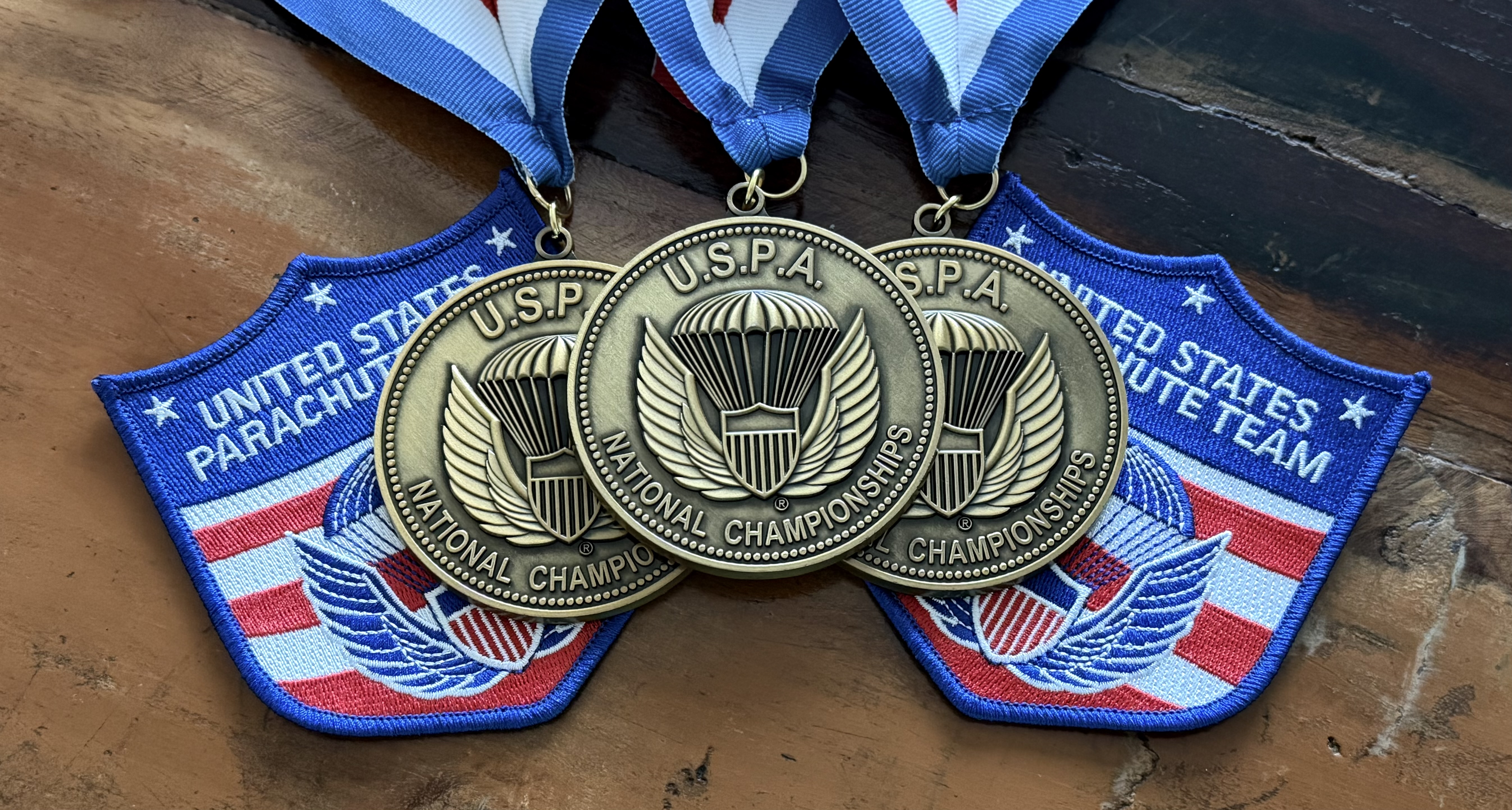
In addition to taking home the gold, Brianne and Nik also set eight new USPA competition records during the competition.

North American Continental Record Submitted
In round 6 Nik exceeded his current (G-2) North American Continental Record – Highest Vertical Speed w/o a Drogue – by reaching 552.56 km/h (343.345 mph). USPA has submitted a preliminary claim to the FAI.
For a relatively young discipline (that continues to evolve rapidly), records are being pushed forward at an incredible pace. Every competition gives athletes another opportunity to refine equipment, technique, body position, and the mental process required to reproduce these speeds when it counts.
That’s ultimately what Speed Skydiving is about.
Going fast once is one thing. Doing it when the pressure is on is something else entirely.
The 2027 United States Speed Skydiving Parachute Team
Congratulations to everyone who qualified for the 2027 United States Parachute Team, which will represent the U.S. at the 2027 FAI World Cup in Brazil next August.
The selected team includes:
Top row, left to right:
John Stilwell, Jordan DuJack, Jessica Twarog, Matthew Fry, Brianne Thompson, Niklas Daniel
Bottom row, left to right:
Joel Williamson, Daniel Osorio, Patrick Kessler, Michael Goodwin

Thank You
Going fast in training is relatively easy. You can control the conditions. You can pick the altitude. You can choose when to jump. You can make another attempt if something doesn’t feel right.
Competition is different.
Competition asks you to produce your peak performance on demand.
Weather. Altitude. Equipment. Fatigue. Other competitors. The clock. The scoreboard. The pressure of knowing that you may have only eight opportunities to put everything together.
That’s what makes competition Speed Skydiving so demanding—and so rewarding.
None of us can do it alone.
As always, AXIS would like to thank the sponsors and supporters who make these adventures possible:
Skydive Arizona, Vertical Suits, UPT, Althoff & Voeller, Cookie, FlySight, L&B Altimeters, and Performance Designs.
We’d also like to thank Meet Director Scott Smith and Chief Judge Steve Hubbard for running a smooth and fair competition under some challenging circumstances.
A huge thank-you goes to the Perris pilots, support staff, and Dan Cook for keeping the operation moving through some very difficult weather.
And a special shout-out to Dirk and Claire of InTime Scoring, who somehow managed to get us our results before we were called to the next aircraft—even with the unusually short turnaround times.
After the awards ceremony, AXIS packed up and headed back to Eloy for the six-and-a-half-hour drive home.
It was a long day.
A very long day.
But with 542.65 km/h on the scoreboard, a new crop of national champions, and the World Championships just around the corner, it was hard to complain.
Next stop: Eloy.
Let’s see how fast we can go.
Leave a Reply