

When the conversation turns to how fast a human can fall, two names reliably come up first: Felix Baumgartner and Alan Eustace. Their high-altitude jumps became the public yardstick for what a human body can manage when it’s falling through atmosphere.
Baumgartner’s 2012 Red Bull Stratos jump is the one everybody knows. He exited at 38,969.4 meters (127,852 feet), hit a maximum vertical speed of 1,357.6 km/h (Mach 1.25), and became the first person to break the sound barrier in freefall without a vehicle. The FAI ratified it as the world record for maximum vertical speed without a drogue.
Two years later, Alan Eustace went higher. He exited at 41,422 meters and reached 1,320 km/h, only about 38 km/h off Baumgartner’s number. Different category, though: Eustace’s maximum vertical speed was achieved with a drogue, which the FAI records separately. And the drogue wasn’t convenience hardware. It was an essential part of the StratEx system, providing stability through the extreme-speed portion of the descent.
Both performances were extraordinary. They also created a problem nobody intended: once the public sees 1,320 or 1,357 km/h, those become the numbers everything else gets measured against.
Cut to Skydive Arizona, August 15th, 2026.
Nik Daniel, by far the world’s most badass candy apple, maxed at 576.437 km/h, in the process snagging two records: a record for Maximum Vertical Speed Without a Drogue, and a AZ state record for Greatest Freefall Speed, besides.
Set next to ±1,300 km/h, 576.437 km/h might not look that…fast.
Hoo boy, but it is.
There is so much more to this story. Let’s investigate.
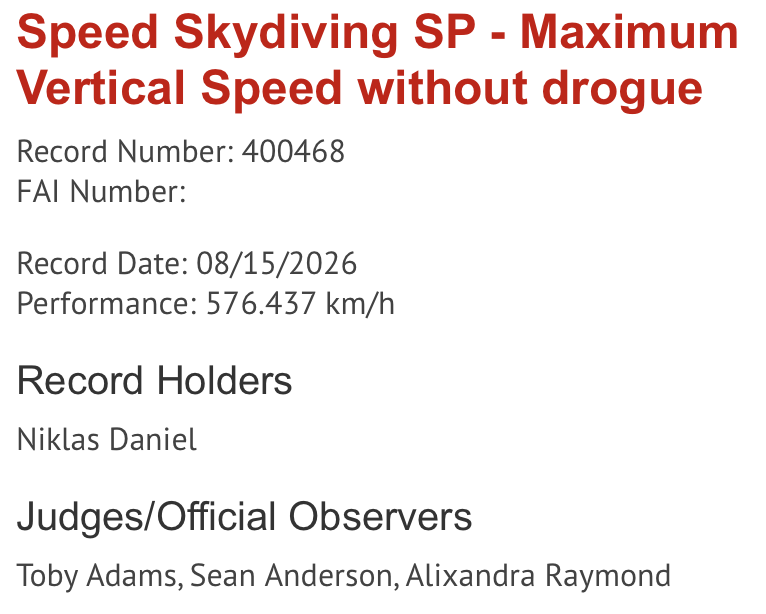
The number is (!) the least interesting part
Nik’s recent performance, currently awaiting ratification, was a fundamentally different exercise from Stratos or StratEx.
Nik exited at approximately 16,499 feet AGL and ended the speed dive at approximately 5,500 feet AGL. That’s roughly 10,999 feet of vertical working distance, and the speed dive lasted approximately 30 seconds.
And, well, no drogue.
As a skydiver, you already know why that matters. At extreme speed, staying stable is the whole aerodynamic problem, and a drogue provides a stabilizing influence that helps keep a jumper out of a dangerous high-speed spin. The FAI specifically notes the drogue’s importance in Eustace’s performance. Nik had nothing doing that job for him, so his stability, body position and aerodynamic control all had to come out of his own flying.
Which makes 576 km/h a different kind of achievement from a drogue-assisted speed record.
Thirty seconds, but do it in five-second slices
Vertical velocity at five-second intervals, approximately:
⏱️ 5 seconds: 199 km/h
⏱️ 10 seconds: 355 km/h
⏱️ 15 seconds: 475 km/h
⏱️ 20 seconds: 547 km/h
⏱️ 25 seconds: 575 km/h
⏱️ 30 seconds: 568 km/h
💥 Maximum recorded speed: approximately 576 km/h.

Arguably, the shape of that curve is more interesting than the peak. Five seconds in, Nik is at about 35% of his eventual maximum. Ten seconds, nearly 62%. Fifteen, about 82.5%. Twenty, roughly 95%. By twenty-five seconds he’s at 575 km/h, which is 99.8% of the 576 km/h peak, and effectively the limit of the dive.
And then he lost it. 🍌 Argh.
At around the 25-second point, an instability. Speed dropped, down to approximately 568 km/h at the 30-second mark. He recovered control and regained speed, but by then he’d reached an aerodynamic plateau anyway.
The 576 km/h figure wasn’t a momentary uncontrolled acceleration that happened to spike. Nik was already at approximately 575 km/h before the instability, then recovered and kept operating in essentially the same extreme-speed regime.
The atmosphere? Not helping.
Altitude is the other enormous difference. Baumgartner had approximately 119,431 feet of vertical freefall distance. Nik used approximately 10,999 feet, about 9.2% of it, which means Baumgartner had nearly eleven times as much vertical distance to develop speed in. Big difference, right.
Air density is the bigger consequence. Baumgartner started in the extremely thin atmosphere of the stratosphere, and as he accelerated and descended, increasing density progressively increased drag. That’s how you build tremendous speed before the much greater resistance lower down shows up.
Nik started at 16,499 feet. Dense atmosphere almost immediately, and it got worse as he got faster. His velocity curve shows exactly that: gains shrinking as he closed on 550 to 575 km/h.
He wasn’t simply falling faster and faster. He was fighting the atmosphere.
The skill hides in the plateau
From outside, speed skydiving looks like an acceleration problem. Get into position, point down and go as fast as possible.
The data say something more complicated. Nik’s initial acceleration was substantial, but as speed built, aerodynamic forces became increasingly dominant. The final 100 km/h cost considerably more work than the first 100. At 547 km/h he was already in a regime where tiny changes in body position carry significant consequences. At 575 there was almost nothing left to gain.
And then the instability.
Recovering from an instability there isn’t a matter of finding a comfortable body position again. It means re-establishing the precise aerodynamic configuration required to keep accelerating while traveling through dense atmosphere at more than 150 meters per second. Nik managed it.
So “576 km/h” doesn’t describe the performance. This does: 576 km/h achieved and controlled without a drogue, in approximately 30 seconds, inside only 10,999 feet of vertical working distance, followed by a recovery from instability while operating near the aerodynamic limit of the dive.
Felix and Alan still matter (obvs)
Gotta say, despite the obviousness: none of this diminishes Baumgartner or Eustace. Quite the opposite. Their performances are the context that lets us understand how difficult extreme human freefall really is.
The FAI continues to recognize Baumgartner’s 1,357.6 km/h as the world record for maximum vertical speed without a drogue. Eustace’s 1,320 km/h is equally remarkable, given that he exceeded Baumgartner’s altitude record and reached almost the same speed on a drogue. The FAI recognizes it as the current maximum vertical speed with drogue record.
But those missions were enormous technological undertakings. Balloons, pressurized capsules, specialized life-support systems, custom suits, extensive engineering teams, mission control, medical expertise, sophisticated equipment. That isn’t a criticism. The objectives were extraordinary, so the resources had to be. It does make comparison with a modern speed skydiving performance difficult.
Nik’s challenge was concentrated instead. Roughly 30 seconds and roughly 11,000 feet, no drogue, and nothing but his own body position and control to extract every possible kilometer per hour from the atmosphere he had.
Are we actually measuring the wrong thing?…
If the only question is who has gone fastest, Baumgartner’s 1,357.6 km/h is the obvious benchmark and there’s nothing left to discuss.
It isn’t the only interesting question. We can also ask how fast a human can make their body fly through dense atmosphere. How much speed a jumper can extract from a few thousand meters of working altitude. How precisely a human can control their body past 500 km/h, and how quickly they can get that control back when it’s disrupted.
And the one we’d put first: how much of the performance comes from the human being, rather than from the environment and technology surrounding them?
Answer those and you get a very different hierarchy of achievement.
Nik’s pending 576 km/h doesn’t threaten Baumgartner’s absolute speed record. It doesn’t need to. Its significance is elsewhere, in what it demonstrates about human aerodynamic skill.
The public sees 576 km/h next to 1,357.6 km/h. Anyone au fait with speed skydiving sees something else: a human being holding a very precise body configuration at close to half the speed of sound, in dense atmosphere, without a drogue, with only a small vertical window to work in, then recovering from an instability near the limits of the dive.
Food for thought!
Photo by Alex Swindle
Leave a Reply