How Long Should You Wait Before You Jump?
You’re in the door. You’ve checked the spot. The group ahead of you just vanished into the blue.
Okay. Now what?
How long do you wait before you follow?
Welcome to one of the most misunderstood—but most important—parts of skydiving: exit separation timing.
Let’s get this nailed down.
Why Exit Separation Isn’t Just a “Feel Thing”
Sure, you’ve probably heard “just count to 8” or “wait until they’re out of sight.” But here’s the deal:
Exit separation isn’t about vertical space.
It’s about horizontal distance—because most accidents happen when jumpers collide under canopy, not in freefall.
If the group ahead has a malfunction… or pulls high… or has a premature deployment… and you’re right on top of them?
Bad day.
So how do we create the space we need?
The Two Key Variables: Fall Rate + Aircraft Ground Speed
We covered the fall-rate side of the equation in our full exit order breakdown here (TL;DR: slowest fallers out first). But when it comes to how long to wait between groups, there’s one big number that matters:
🛩️ Aircraft Ground Speed
Why? Because the faster the plane is moving over the ground, the more horizontal space gets created in a shorter amount of time.
A Rule of Thumb: The 80-8
We love a good rule of thumb. And this one sticks:
80 knots = 8 seconds
That’s your easy baseline. But let’s play with the variables.
| Ground Speed (knots) | Recommended Delay |
|---|---|
| 60 knots | ~10 seconds |
| 80 knots | 8 seconds |
| 100 knots | ~6 seconds (minimum) |
If the winds aloft are cranking and your ground speed drops? Add time.
If you’re zooming along with a tailwind? You can safely leave less—but don’t cut it too close.
Nik’s personal rule?
“Even if the ground speed is high, I don’t like anything less than 6 seconds. That’s my floor.”
Pro Tip: Don’t Shout Numbers Too Early
A common mistake: someone checks ground speed too early—before jump run configuration—and ends up using a speed from the climb.
That’s…not helpful. Make sure you’re using the number from when the aircraft is level and on jump run.
Best case? Ask the pilot when they’re not busy—or peek at the GPS yourself if you’re near the cockpit.
Still Unsure? We Built You a Calculator.
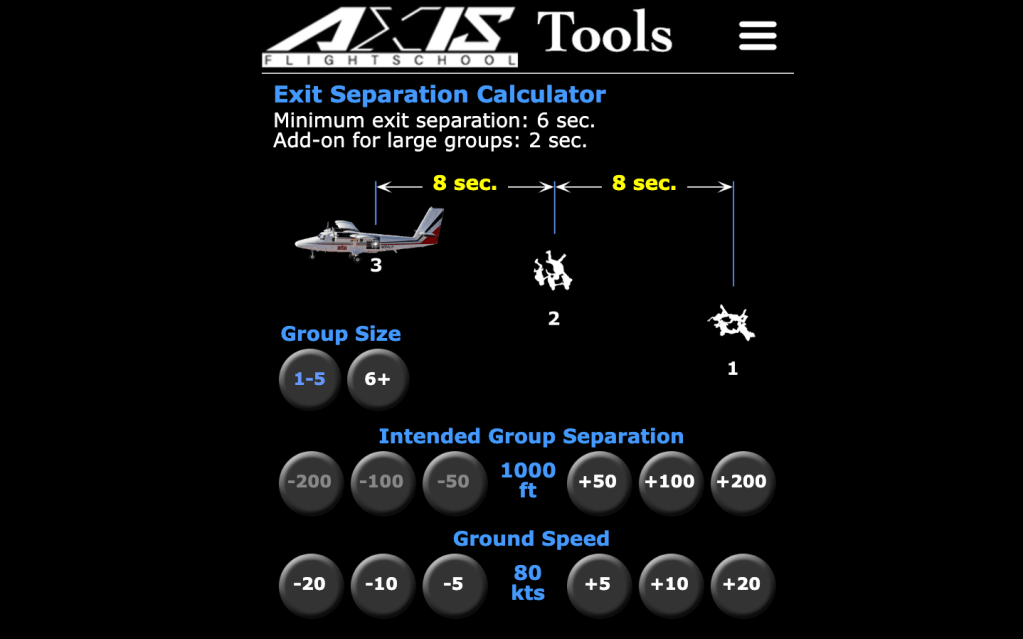
No joke. There’s a handy exit separation calculator over on our website:
🔗 AXIS Flight School Separation Calculator
Plug in your aircraft’s ground speed and boom—recommended separation, sorted. Use it. Share it. Save yourself the guesswork. Ya welcome.
Counting Beats Guessing
At 80 knots, count:
One Mississippi… two Mississippi… three… all the way to eight Mississippi.
Do that, and you’re giving your fellow skydivers a fighting chance to clear your path—and you theirs.
One Final Thought: Safety > Schedules
We get it—DZs don’t love go-arounds. Fuel is expensive, loads are tight and you have a lot to accomplish in your time on the DZ. But here’s the truth: Schedules and safety don’t always get along. Performance and safety will always be in tension. Your job is to make the best call you can with the data you have—then hold the door when you need to.
Because a few extra seconds is always cheaper than a collision.
🙌 Many thanks to Blue Skies, Fun Days for hosting Nik for a really fun podcast episode on this subject!
👀 Want to get nerdy with more pro tips like this?
Subscribe to AXIS Flight School on YouTube—and bring your brain to your next jump.
🎯 Got questions? We’ve probably answered them. Or we’re about to. Drop us a comment (or message) and we’ll get it sorted.

 The Drop
Leave a comment