Ever been the last one out of the plane and wondered if someone drew straws without telling you? Or found yourself floating solo in an ocean of skydivers and wondering how the exit order got so out of whack? Let’s sort that out.
Here’s the good news: there is a system. A smart one. And when it’s followed well, it means everybody in the air has a safe, happy, drama-free jump.
Let’s break it down.
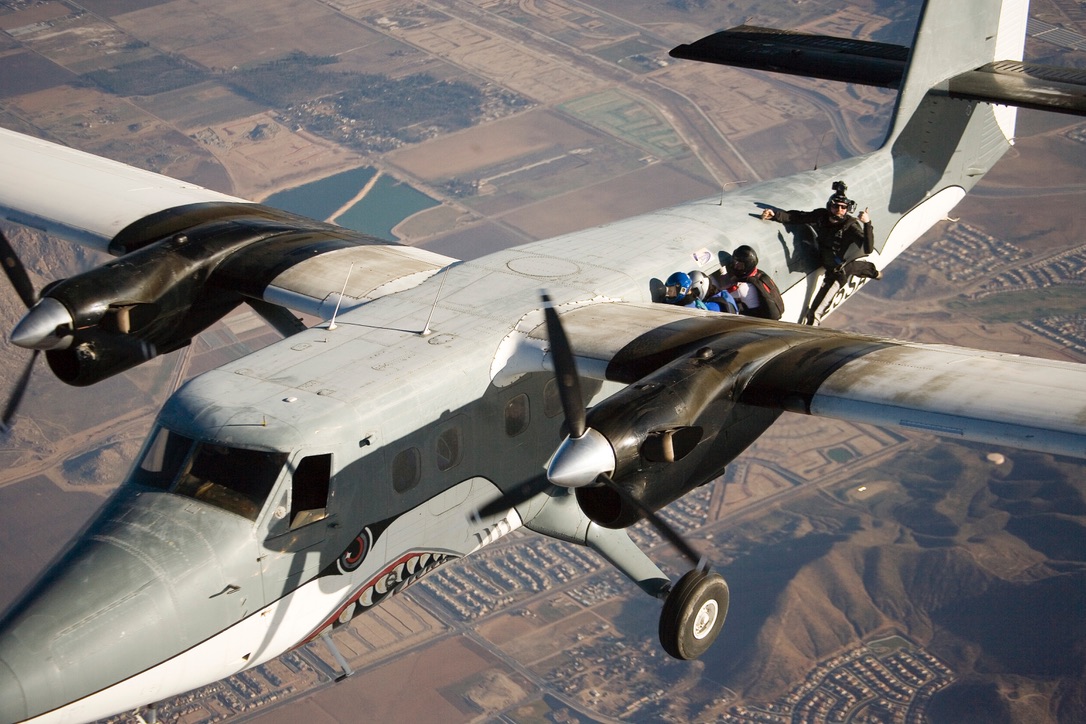
What is Exit Order, Anyway?
At its core, exit order is all about airspace deconfliction—a fancy way to refer to the art of making sure every group that exits the aircraft has enough room in the sky to do their thing without colliding with someone else mid-jump (or mid-deployment). It’s also about managing separation so that if something does go off plan, there’s still enough room to recover.
To do that, we don’t just think about where people are in the plane. We think about:
- How fast they fall
- What direction they’re flying
- How much time it takes to set up
- And how their canopies might interact on the way down
Who Goes First?
Here’s the general rule:
🪂 Slow fallers out first. Fast fallers out last.
This usually means:
- Big belly groups
- Smaller belly groups
- Freefly groups, large to small
- Movement jumps (angle/tracking)
- Wingsuiters, tandems, AFF, and solos round things out based on DZ policy
Why the slowpokes first? Because floatier jumpers stay aloft longer and drift more. That drift can actually help increase separation from the faster-falling groups behind them—if we manage the timing and spacing correctly.
Time = Distance = Safety
We aim for about 1,000 feet of horizontal separation between groups. That number can flex a bit depending on ground speed, weather, and the number of groups on the load.
Slower fallers + more drift + properly timed exits = smooth skies for all.
Just be mindful: more separation = more fuel burn = DZ grumbles. So it’s a balancing act.
Math not your strongest suit? No problem. AXIS made you an Exit Separation Calculator, which you can find ➡️ here.
You’re welcome!
What About Movement Groups and Wingsuits?
This is where things get 🌶️.
Movers (angle flyers, trackers) and wingsuits don’t just fall—they fly. And they can do it fast and far. So they have to communicate clearly and exit with intention.
Some DZs want movement groups out first, so they punch off the line of flight early. Others slot them in just before freeflyers if the group is steeper and falls faster. Either way: clear intentions, solid planning, and no surprises.
And yes—moving in opposite directions (e.g., one group east, one west) is a viable tactic, as long as it’s planned and briefed.
Exit Order Isn’t Just About Freefall
One often-overlooked piece? Canopy flight.
Let’s say you’ve got two otherwise similar groups—but one’s flying tiny canopies, and the other’s floating on big student wings. You might want the small-wing crew to exit first, so they don’t have to hang out forever waiting for the big boys to land.
The goal: avoid stacking, overtaking, or cutting each other off on final. Safety from exit to landing.
One Last Thing: FFS, SPEAK UP
Every dropzone is different. They each have their own culture, policies, aircraft, and jump run preferences.
Don’t guess. Ask. Brief. Confirm. Communicate.
And if you’re planning a specialty jump (speed skydiving, wingsuit rodeo, etc.), make sure manifest and the rest of the load know what’s happening.
You don’t have to know all the variables. You just need to be a good skydiving citizen. Be curious. Be courteous. Be clear.
Got questions—or want to fine-tune your skills? Hit us up at AXIS Flight School. We live for this stuff.
📺 P.S. Check out Nik’s full explanation on YouTube (as a guest on Blue Skies Fun Days)
📩 …And subscribe to the newsletter to stay sharp and stay safe!
 The Drop
Leave a comment